Collaboration: The Geometry of Flourishing
Technologies of the Heart — Volume II, Chapter 4
Part of the Technologies of the Heart series | The Heart of Peace Foundation
← Chapter 3 — Paying It Forward | Next: Chapter 5 — Compassion as Inner Clarity →
In the summer of 1957, Rosalind Franklin was working alone. Not by preference — by institutional design. Her photographs of DNA, produced at King's College London through meticulous X-ray crystallography, were the most precise images of the molecule ever captured. Photograph 51, produced in May 1952, contained within its dark rings and bright spokes a precise answer to the question that had obsessed the world's best structural biologists for a decade: what is the shape of the molecule of life?
Franklin did not get to finish answering it. Her data was shown — without her knowledge, without her consent — to James Watson at Cambridge in January 1953. Watson was working in close daily collaboration with Francis Crick, a physicist-turned-biologist who brought a completely different toolkit: an intuitive grasp of three-dimensional molecular geometry, a willingness to build physical models and argue from their properties rather than just from data, and — crucially — a partner who pushed back on every assumption. Within weeks of seeing Franklin's photograph, Watson and Crick had produced a structural model of DNA that remains one of the most consequential scientific discoveries in human history.
The story of DNA has a dark edge — Franklin's contribution was systematically minimized during her lifetime, and the Nobel Prize awarded in 1962 to Watson, Crick, and Maurice Wilkins did not include her. That injustice is real and must be named. But embedded in the story is also a precise demonstration of something that the injustice has tended to obscure: what Watson and Crick had, and what Franklin — brilliant, rigorous, and working in near-total isolation from genuine intellectual partnership — did not have in time, was each other. Two minds approaching the same problem from different disciplines, who could argue across paradigm lines and correct each other's blind spots in real time. Who could produce, together, not just more than either could produce alone, but something structurally different from what either could have produced alone.
The double helix was not the achievement of Watson. It was not the achievement of Crick. It was the product of a particular kind of collision — what chemists would call a reaction that does not merely combine the reactants but changes their fundamental nature.
This is what collaboration actually is. Not compromise. Not the pooling of separately-owned capacities. A reaction that produces something categorically new.
What this article reveals:
- Genuine collaboration is not compromise — it is convergence, in which two or more perspectives unite around a shared purpose and produce outcomes neither could achieve alone
- Robert Axelrod's computer tournaments demonstrated that cooperation is not naïve — it is the strategy that wins in any game with a long enough horizon; the shadow of the future transforms rational actors into collaborative partners
- Elinor Ostrom's Nobel Prize research proved that communities have governed shared resources sustainably for centuries without either privatization or government control, demolishing the "tragedy of the commons" myth with empirical evidence from dozens of cultures
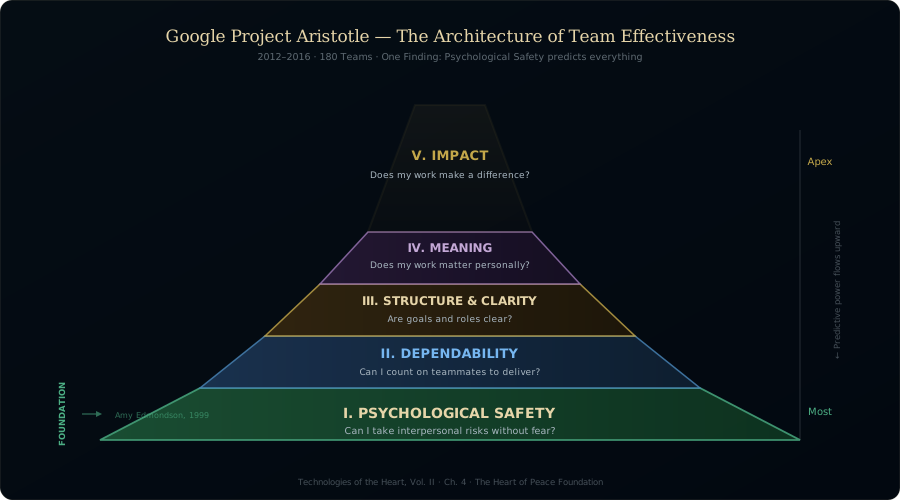
- Amy Edmondson's research at Harvard identified psychological safety — the shared belief that one can speak up without fear — as the single most predictive factor for team performance, confirmed across 180 teams in Google's Project Aristotle
- Martin Buber's "I–Thou" framework and David Bohm's dialogue process each describe the same phenomenon from different traditions: a quality of encounter in which two genuine subjectivities meet, and something emerges between them that belongs to neither alone
- The Ubuntu philosophy of Southern Africa — "I am because we are" — is not a sentiment but an operating philosophy of personhood that has governed communities, courts, and resource-sharing for centuries; it describes the metaphysical structure that genuine collaboration enacts every time it happens
- Collaboration is not a human invention or a cultural preference — it is, as Martin Nowak of Harvard demonstrated, one of the five primary mechanisms by which natural selection itself operates; cooperation is woven into the logic of life
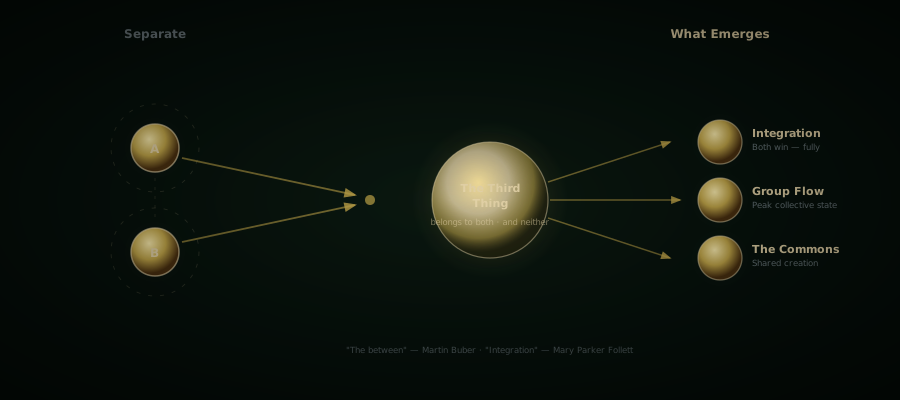 The geometry of collaboration: what arises at the meeting point belongs to both parties and to neither — larger than either could produce alone.
I. Introduction — Collaboration as Geometry
We have developed, over centuries of organizational thinking, a deeply impoverished model of collaboration: two or more people pooling what they separately have, dividing up tasks, and recombining the results. This is coordination. It is useful. It can be made efficient. But it is not collaboration in the sense that produces genuine breakthroughs — in science, in art, in social organizing, in community building.
Genuine collaboration is a different phenomenon. It is the emergence of something that neither party could have produced — or even envisioned — before the encounter. In the language of geometry, it is not the midpoint between two positions. It is a third point, located in a dimension that neither position alone could access.
The social psychologist Morton Deutsch at Columbia University spent forty years studying what he called the theory of cooperation and competition — when and why people working together produce more than they would alone. His central finding, first articulated in his foundational 1949 dissertation and refined over decades of research into conflict resolution, educational psychology, and organizational behavior, is that the key variable is not how smart or skilled the individuals are. It is how their goals are structured.
When people have positively interdependent goals — when each person's success genuinely requires and is genuinely required by the success of the others — they do not merely add their capacities. They multiply them. They take risks they would not take alone. They share information they would otherwise protect. They discover solutions they could not have reached in isolation. They become, in Deutsch's precise formulation, a system with emergent properties — a collaborative whole that behaves differently from the sum of its parts.
The inverse is equally precise: when people have negatively interdependent goals — when one person's gain genuinely requires another's loss — they systematically withhold information, resist change, undermine each other in ways that are often invisible and frequently unconscious. They become a system with subtractive properties. The whole underperforms the sum of its parts. Most of our institutions are organized around precisely this structure. This is not an accident, and its consequences are not small.
This chapter's thesis:
Genuine collaboration is not two people meeting in the middle. It is two or more people discovering a third thing — a possibility that exists only in the space between them — and that discovery is always larger than what either brought to it.
The geometry of that discovery — how it happens, what makes it possible, what prevents it, and how its logic is woven into the deepest structures of nature, culture, and the human nervous system — is what this chapter traces.
II. Historical Context — The Science and Philosophy of Cooperation
The Evolutionary Logic of Cooperation
For most of the twentieth century, the dominant narrative about human nature and cooperation derived, improbably, from a cold war nuclear standoff. The Prisoner's Dilemma — a game-theoretic thought experiment formalized by RAND Corporation researchers Merrill Flood and Melvin Dresher in 1950 and named by Albert Tucker — presented two individuals who, facing the choice between cooperation and betrayal without the ability to communicate, both rationally choose betrayal and both receive worse outcomes than they would have from mutual cooperation. The conclusion drawn from this model was widely understood to be: rational actors will not cooperate.
This conclusion turned out to be wrong, in a precise and empirically demonstrable way. The wrong lay not in the logic of the game but in a hidden assumption: that the game is played only once. When Robert Axelrod at the University of Michigan asked the question in 1980 — what happens when the game is played repeatedly? — the answer changed the field.
Axelrod invited game theorists, economists, psychologists, and computer scientists to submit strategies for an iterated Prisoner's Dilemma tournament. Fourteen strategies of varying sophistication were entered. The winning strategy was submitted by Anatol Rapoport, a mathematical psychologist at the University of Toronto, and it was disarmingly simple: cooperate on the first move; thereafter, do whatever your opponent did on the previous move. Cooperate if they cooperated. Defect if they defected. Rapoport called it Tit for Tat.
Tit for Tat won not because it was clever but because it was nice (never the first to defect), retaliatory (not exploitable), forgiving (immediately resuming cooperation after punishing defection), and clear (its pattern was easy for opponents to read and respond to). In his 1984 book The Evolution of Cooperation, Axelrod made the finding generalizable: cooperation between self-interested agents emerges spontaneously — without central coordination, without altruism, without enforcement — when they expect to interact again. The shadow of the future is the mechanism. When tomorrow matters, cooperation is not idealism. It is strategy.
Axelrod's tournament revealed something deeper than a game-theoretic trick. It revealed that cooperation is not contrary to self-interest in an iterated world. In any environment where individuals can expect repeated interaction — any village, any professional network, any relationship — the selfish strategy and the cooperative strategy converge. The tragedy of non-cooperation is a tragedy of time horizon.
Martin Nowak at Harvard extended this framework in a landmark 2006 paper in Science titled "Five Rules for the Evolution of Cooperation." Nowak identified five mechanisms by which cooperation can evolve through natural selection without requiring altruistic sacrifice:
- Direct reciprocity: cooperation evolves when individuals interact repeatedly and can condition their behavior on a partner's history — the mechanism Axelrod documented
- Indirect reciprocity: cooperation evolves through reputation — when helping others in public builds a record that others will help you in turn; Nowak and Karl Sigmund demonstrated mathematically that image scoring drives more cooperation than direct reciprocity alone
- Network reciprocity: the structure of social networks creates clusters of cooperators who interact with each other more than with defectors; cooperators thrive in the interior of clusters even when defectors would win in a well-mixed population
- Kin selection: organisms cooperate with genetic relatives because their fitness is partially shared — the mechanism Hamilton's rule describes
- Group selection: groups with higher proportions of cooperators outcompete groups with lower proportions, driving cooperation at the between-group level even when within-group incentives favor defection
What Nowak's synthesis makes clear is that cooperation is not an anomaly within natural selection — it is one of natural selection's primary tools. Evolution does not merely tolerate cooperation; it actively uses it as a mechanism for generating complexity. Every multicellular organism is cooperation at the cellular level. Every ecosystem is cooperation at the organismal level. Every language is cooperation at the cognitive level. The deepest structure of living systems is collaborative.
The Philosophical Lineage — From Aristotle to Buber
The scientific tradition's engagement with cooperation is less than a century old. The philosophical tradition's engagement is considerably older — and reaches depths that the scientific framework is only beginning to touch.
Aristotle's Politics opens with a claim that has reverberated through every subsequent theory of human society: anthropos phusei politikon zōon — the human being is by nature a political animal. He did not mean "political" in the electoral sense. He meant that humans are, at the level of their nature, beings who can only fulfill their nature in the context of community. Aristotle was precise about this: the city-state (polis) is not a convenience that humans adopt for safety or efficiency. It is the condition in which human nature can actually become what it is. Outside the community, Aristotle wrote, what you have is either a beast or a god. The human is constituted by its relationships.
This is a philosophical claim with structural implications: if the human being is constituted by relationship, then collaboration — genuine, mutual, other-transforming encounter — is not something humans do. It is something humans are. The failure to collaborate is not just a strategic error or a social deficiency. It is, in Aristotle's terms, a failure to be fully human.
This thread runs through the whole of Western philosophy, but it reaches its most intense articulation in the work of Martin Buber, the Austrian-Israeli philosopher whose 1923 book I and Thou has been called one of the twentieth century's most important philosophical texts. Buber's distinction is elegantly simple and structurally profound: there are two fundamental modes of existence, two ways of relating to the world and its contents. The first is the I–It relationship: the stance in which I encounter the other as a thing, an object, something with attributes that I can categorize, use, or manage. The second is the I–Thou relationship: the stance in which I encounter the other as a subject — a genuine, full, irreducible presence — and in encountering it, am myself encountered. In the I–Thou relation, both parties are changed. The encounter produces what Buber called the "between" — a relational space that did not exist before the meeting, a third reality that belongs to neither party and to both.
Buber's insight is not mystical in a vague sense; it is precise in a geometrical sense. What he is describing is the structural condition under which genuine collaboration becomes possible: not two subjects managing a transaction, but two genuine presences meeting across the space between them, and discovering in that meeting something neither possessed before. Every genuine collaborative breakthrough — in science, in art, in conflict resolution, in community building — has this structure. It is the structure of the third thing.
The organizational theorist Mary Parker Follett — working in the 1920s, largely ignored by her contemporaries, and now recognized as one of the founding theorists of modern organizational science — named this structure "integration" and distinguished it sharply from "compromise." In compromise, both parties give something up. The solution is located in a zone neither fully wanted. In integration, both parties bring their genuine interests fully forward and work together to find a solution that satisfies both — a solution that, precisely because it emerges from genuine engagement with the full complexity of the situation, is usually better than anything either party proposed. Follett's key insight: integration is not possible when parties argue from positions. It becomes possible when parties reveal their underlying interests — what they actually need, not just what they initially asked for.
Follett was writing decades before Roger Fisher and William Ury formalized these same insights in Getting to Yes (1981), the foundational text of principled negotiation. Their principle of "separating positions from interests" is Follett's insight, arrived at independently through entirely different methods. This convergence — a mathematician and an organizational theorist reaching the same structural insight from different starting points — is itself a demonstration of the third thing. The principle that makes integration possible was more robustly confirmed by having been discovered twice.
The Science of Team Performance — What Organizational Research Found
The history of organizational research on collaboration is a history of discovering, repeatedly and at great expense, what common sense and ancient wisdom already knew — and then finding the precise mechanisms that explain why it is true.
The history begins with the Hawthorne Studies in the 1920s and 30s, conducted by Elton Mayo and his colleagues at Western Electric's Hawthorne Works outside Chicago. The original intent was to study the relationship between environmental conditions (lighting, temperature, hours) and worker productivity. What the researchers kept finding, to their bewilderment, was that productivity improved whenever they changed something — regardless of whether the change was an improvement in conditions or a deliberate worsening. The effect could not be attributed to the environmental variables. It was attributed, in the first published interpretation, to the fact of being observed and included — the social and relational dimension of work that industrial management models had entirely omitted.
The Hawthorne Studies were methodologically flawed in several respects, and subsequent researchers have challenged their specific findings. But their importance was not their conclusions — it was what they forced into the frame: the recognition that organizational performance cannot be understood without accounting for the social and relational dynamics of the people doing the work.
It took another sixty years for the precise mechanism to be identified. Amy Edmondson at Harvard Business School, beginning with a landmark 1999 study of hospital nursing teams and continuing through three decades of research, identified what she called psychological safety — the shared belief that the team is safe for interpersonal risk-taking, specifically the belief that one can speak up, raise concerns, ask questions, or acknowledge mistakes without fear of punishment or humiliation. Her finding was initially counterintuitive: the best-performing teams in her hospital study had the highest reported error rates. The initial assumption was that high-performing teams made fewer errors; the actual finding was that they reported more errors because they operated in an environment where reporting was safe.
Edmondson's work was confirmed at massive scale by Google's Project Aristotle, a two-year research initiative (2012–2016) that studied 180 teams within Google to identify what made teams effective. The study controlled for team composition, individual talent, organizational structure, and dozens of other variables. The single most predictive factor for team effectiveness was psychological safety — the same variable Edmondson had identified in hospital settings. Not individual talent. Not team composition. Not organizational support. The degree to which team members felt safe to take interpersonal risks.
The structural implication of Edmondson's research is precise: the most important condition for collaboration is not intellectual capacity — it is the quality of the relational field. Teams that produce genuinely creative outcomes are not teams where the smartest people happen to be assembled. They are teams where the social conditions allow the intelligence that is already present to operate without the constant tax of self-monitoring, status management, and defensive positioning. The third thing — the emergent creative breakthrough — does not appear despite the relational dimension of collaboration. It appears through it.
III. The Third Thing — What Emerges at the Point of Convergence
The Jazz Ensemble and the Score That Writes Itself
On the evening of July 17, 1955, Miles Davis walked into a recording studio on Thirty-first Street in New York with a group of musicians he had rarely played with before: pianist Red Garland, bassist Paul Chambers, drummer Philly Joe Jones, and alto saxophonist Julian "Cannonball" Adderley. The session produced Round About Midnight, an album that many critics consider one of the most perfectly realized ensemble jazz recordings ever made.
What makes the album remarkable is not the technical virtuosity of its individual musicians — though that virtuosity was exceptional. What makes it remarkable is what happened between the musicians. Jazz improvisation is a form of real-time collaborative composition: each player is simultaneously responding to what every other player just did, anticipating what they might do next, and extending the harmonic and rhythmic conversation in ways that are intentional and spontaneous at once. There is no score for this. The score writes itself, in real time, from the interaction of the players.
Keith Sawyer, a cognitive psychologist who trained as a jazz pianist before becoming a researcher, spent years studying jazz ensembles as models of collaborative creativity. His central finding in Group Genius: The Creative Power of Collaboration (2007): the creative output of a jazz ensemble is not the sum of the individual improvisations. It is an emergent property of the interaction — something that could not have been predicted from analyzing any individual player in isolation. The music is generated between the musicians. It is the third thing, continuously produced and continuously consumed by the very collaboration that produces it.
Sawyer identified the conditions under which this kind of emergent collaborative creation becomes possible:
- Deep, genuine listening: each player hears every other player as a source of ideas to be developed, not as background noise to be managed
- The suspension of ego in service of the music: the best idea in the ensemble is more important than whose idea it is
- A shared language of deep familiarity: players who have played together develop not just technical attunement but a kind of anticipatory understanding — they know, before the phrase is finished, where it is going, and they can choose to complete it or subvert it
- A shared goal that is specific enough to orient action but open enough to allow genuine exploration: jazz standards provide the harmonic skeleton; the improvisation provides the flesh
- Matched capacity across the ensemble: flow states cannot be sustained when one player is operating at a fundamentally different level from the others
These conditions are not exclusive to jazz. They describe the structural requirements for any form of genuine collaborative creativity — in science, in organizational problem-solving, in community building, in the negotiation of conflict. They describe, in operational terms, what Buber was pointing at philosophically: the relational field in which the third thing can emerge.
David Bohm and the Collective Mind
The physicist David Bohm, best known for his work on quantum theory and the implicate order, spent the last decades of his life developing a practice he called Dialogue — distinct from discussion and debate in a precise and important way. In a 1989 paper co-authored with Donald Factor and Peter Garrett, Bohm described the distinction this way: the Latin root of "discussion" shares its root with "percussion" and "concussion" — it is about striking, breaking down, separating. Discussion is the attempt to establish which position is correct by forcing positions into collision. Dialogue, from the Greek dia-logos, means something closer to meaning flowing through — the movement of shared meaning through a group in a way that allows new understanding to emerge that no individual brought to the session.
Bohm proposed that groups engaged in genuine Dialogue could access what he called the collective mind — a form of intelligence that is genuinely distinct from the aggregated intelligence of individuals, that operates at a higher level of coherence, and that can perceive patterns invisible to any individual operating alone. This is not a mystical claim. It is an empirical one, and it is supported by the same evidence base that Edmondson's and Sawyer's research provides: groups in the right relational conditions produce outputs that cannot be explained by analyzing the inputs.
Bohm's practice for accessing the collective mind requires specific conditions: suspending assumptions rather than defending them; listening as a peer rather than as a judge; allowing meaning to emerge from the group rather than arriving pre-formed in any individual's mind. These are not comfort conditions. They are, in Bohm's precise language, conditions of suspension — the temporary release of the certainty structures that normally organize perception — which is genuinely uncomfortable for most people trained in conventional adversarial thinking.
The discomfort is the point. The third thing — the emergent insight, the creative breakthrough, the collaborative solution — appears precisely in the space that opens when participants release their grip on their own positions. It cannot be produced by any individual, because it is, by definition, what no individual's position contained. It is the product of the space between positions, which only opens when positions loosen their grip on the frame.
The Organizational Theorist Who Named It First
Mary Parker Follett's "integration" is the earliest formal description in the organizational literature of what Buber and Bohm each describe from philosophical and scientific perspectives. Her 1925 paper "Constructive Conflict" contains what is perhaps the clearest operational account of how the third thing appears:
"I can not get my way and you can not get yours — as we each conceived our way before we talked together. But if we both have our whole purpose in mind, and both recognize the significance of the other's purpose, the chances are great that we can find a third path which is better for both of us than either of the paths we started with."
The phrase "as we each conceived our way before we talked together" is the key. The third thing is not a compromise between pre-existing positions. It is a new possibility that does not exist before the genuine encounter. It appears because the encounter itself changes the nature of the problem — changes what is visible, what is at stake, and what counts as a solution. Follett's integration is not a diplomatic technique. It is a structural description of how genuine encounter transforms the solution space.
IV. The Geometry of Flourishing — Structures That Enable
Positive Interdependence — The Core Condition
Morton Deutsch's insight — that the structure of goal interdependence determines whether collaboration produces more or less than individual effort — has been validated across decades of subsequent research in settings ranging from elementary school classrooms to international diplomatic negotiations.
In what became known as interdependence theory, Deutsch identified the conditions under which people working together systematically outperform the same people working alone:
- They need to believe that their individual success is genuinely linked to the success of others (positive interdependence)
- They need mechanisms for direct, substantive interaction — not just coordination but genuine exchange of thinking, not just information transfer but meaning-making together
- They need both individual accountability and collective responsibility — the dual structure that prevents the free-rider problem without collapsing into groupthink
- They need what Deutsch called promotive interaction: the behaviors of helping each other, sharing resources, providing feedback, challenging each other's reasoning, and encouraging each other's continued effort
- They need interpersonal skills: the ability to disagree without withdrawal, to hold tension without collapse, to maintain genuine engagement with a perspective that differs significantly from one's own
The last condition is the most demanding and the most important. The capacity to remain in genuine engagement with someone whose understanding differs from yours — without either capitulating to their view or retreating to the safety of your own — is the essential collaborative skill. It is not comfortable. It is specifically the discomfort of being genuinely changed by another perspective while still being genuinely yourself. Deutsch called this "creative tension." It is the same phenomenon that Keats called "negative capability" — the capacity to remain "in uncertainties, mysteries, doubts, without any irritable reaching after fact and reason." It is what allows the third thing to emerge, because the third thing lives precisely in the space that opens when certainty loosens its grip.
David W. Johnson and Roger T. Johnson at the University of Minnesota extended Deutsch's framework into educational and organizational settings through decades of meta-analytic research. Their synthesis, covering hundreds of studies across multiple cultures and age groups, consistently shows that cooperative goal structures — those designed around positive interdependence — produce superior outcomes on every measure that matters: academic achievement, higher-order thinking, creative problem-solving, social skills, psychological wellbeing, and intrinsic motivation. The effect is robust and consistent: cooperative structures outperform competitive and individualistic structures by roughly half a standard deviation across the literature.
This is not a small effect. A half-standard-deviation advantage, sustained across the full duration of an educational career, produces measurable differences in life outcomes. Collaboration, properly structured, is simply a more powerful way to think — and the research has been establishing this fact for seventy years.
Robin Dunbar and the Architecture of Trust
The anthropologist Robin Dunbar at the University of Oxford made a discovery in the early 1990s that has become one of the most widely cited findings in social science: there is a consistent upper limit to the number of people with whom any human can maintain genuine social relationships — characterized by mutual knowledge, ongoing engagement, and a degree of trust — and that number is approximately 150.
Dunbar's number is not an arbitrary cultural artifact. It is derived from the ratio of neocortex size to total brain volume across primate species: larger-brained primates consistently maintain larger stable social groups. The relationship is log-linear and robust across dozens of primate species. Applied to human neocortex size, the equation predicts a social group of roughly 100 to 250, with 150 as the median.
What makes this finding significant for understanding collaboration is what it implies about scale. Below roughly 150 people, organic trust-based collaboration — the kind that does not require elaborate formal hierarchy to function — is possible and, in the right conditions, natural. Members know each other, know each other's histories, know each other's capabilities and limitations. Reciprocity is tracked informally. Reputation is legible without a formal review system. Conflict is managed through direct relationship rather than through institutional procedure.
Above that number, something changes. The cognitive load of tracking all the relevant social relationships exceeds what the neocortex can reliably process. Formal roles, rules, and bureaucratic structures become necessary to coordinate behavior that, in smaller groups, coordinates through informal reciprocity and mutual regard. This is not a failure of institutional design. It is a biological constraint shaping institutional design.
The most successful large collaborative enterprises — open-source software communities, jazz ensembles that grow into orchestras, religious communities that maintain intimacy across hundreds of members, the most effective global nonprofits — do so by creating nested structures of smaller groups, each operating at the scale where organic trust is possible, linked together through shared purpose, shared protocol, and shared accountability into larger configurations. The largest successful commons governance institutions in Ostrom's research all have this nested structure. It is not a coincidence.
V. Cross-Cultural Lineages — Indigenous, Eastern, and Commons-Based Models
Elinor Ostrom and the Demolition of the Tragedy
The conventional wisdom on shared resources — rivers, fisheries, forests, community irrigation systems, community pastures — held, for most of the twentieth century, that they were doomed. The biologist Garrett Hardin formalized this intuition in his 1968 essay "The Tragedy of the Commons," published in Science: when a resource is shared by many, each individual has an incentive to extract more than their fair share, because the benefits of over-extraction accrue to the individual while the costs of resource depletion are distributed across the group. The rational actor, Hardin argued, will always over-extract. The commons will always collapse. The only solutions are privatization (assigning property rights to individuals who then have an incentive to maintain their own property) or government control (centralized authority setting and enforcing extraction limits).
The problem with Hardin's analysis — as Elinor Ostrom spent her career documenting — is that it describes an abstraction, not a reality. Real human communities managing real shared resources are not composed of isolated, anonymous, non-communicating rational actors playing a one-shot game. They are communities: people who know each other, who have histories with each other, who expect to continue interacting, who develop norms, institutions, and governance structures for managing their shared resources. And the historical record of how such communities actually behave is dramatically different from what Hardin's model predicts.
Ostrom spent decades collecting and analyzing empirical case studies: Swiss alpine meadow commons managed sustainably by villagers for over five hundred years; Japanese village forests (iriai lands) maintained collectively since the sixteenth century; irrigation systems in Spain (huertas) operating under community governance since the medieval period; communal fishing grounds in Maine, Turkey, and Nova Scotia. In 2009, she became the first woman to receive the Nobel Prize in Economic Sciences, awarded specifically for this research.
Her book Governing the Commons (1990) identified eight design principles that characterize successful commons governance across cultures and centuries:
- Clearly defined boundaries: the community knows who is and who is not a member, and what constitutes the shared resource
- Rules adapted to local conditions: governance is specific to the actual ecological and social context, not imposed from outside
- Collective-choice arrangements: those who are affected by the rules can participate in modifying them
- Monitoring: members monitor both the resource and each other's compliance — and the monitors are themselves accountable
- Graduated sanctions: violations are met with proportional response, not automatic exclusion; the first violation is treated differently from the twentieth
- Conflict-resolution mechanisms: disputes are resolved within the community, through accessible and low-cost processes
- Recognition of rights to organize: the community's right to self-govern is recognized by the larger system around it
- Nested enterprises: for larger systems, governance is organized in multiple layers of nested institutions
These principles did not emerge from theory. They were distilled empirically from communities that had already succeeded. They represent, in Ostrom's own framing, a third way between the privatization solution and the government-control solution — a solution that requires neither private property nor central authority, but only a community capable of designing and enforcing its own governance.
Ostrom's research demolished the idea that shared governance is inherently unstable. What she showed is that collaboration at scale — genuine, ongoing, adaptive collaboration around shared resources — is not only possible but has been practiced successfully across cultures and centuries. The tragedy of the commons is not inevitable. It is a failure of collaborative design. When the design is right, the commons is not a tragedy. It is one of the most enduring and effective forms of human organization ever documented.
Ubuntu — The Ontology of Collaboration
In the philosophical traditions of Southern Africa, particularly among the Nguni Bantu peoples of what is now South Africa, Zimbabwe, Mozambique, and the surrounding region, there is a concept so central to ethical and social life that it requires its own untranslatable word: Ubuntu.
Ubuntu is usually rendered in English as "I am because we are" — the recognition that personhood is not a property of isolated individuals but is constituted through relationship. A person is a person through other persons. Human identity is relational all the way down. This is not a metaphor or a sentiment. It is a claim about ontology — about what a human being is — that has profound practical implications for how communities organize governance, justice, resource-sharing, and conflict resolution.
Desmond Tutu, the South African Archbishop and Nobel Peace Prize laureate, described Ubuntu this way: "A person with Ubuntu is open and available to others, affirming of others, does not feel threatened that others are able and good, for he or she has a proper self-assurance that comes from knowing that he or she belongs in a greater whole and is diminished when others are humiliated or diminished, when others are tortured or oppressed."
The philosophical move Ubuntu makes is to locate the source of personal security not in the individual's separateness — not in their capacity to acquire and defend their own — but in the quality of the web of relationships in which they are embedded. The well-resourced isolated individual is, in the Ubuntu frame, less a person than the poorly-resourced member of a thriving community. Because personhood is constituted through relationship, to diminish or destroy one's community is to diminish or destroy oneself. The logic of Ubuntu makes genuine collaboration not just ethically preferable but ontologically necessary.
The Truth and Reconciliation Commission in post-apartheid South Africa drew explicitly on Ubuntu principles in its design — the commitment to restorative rather than retributive justice, to the healing of the relational fabric rather than the punishment of isolated offenders, emerged directly from this philosophical tradition. The commission's work was imperfect, but its very existence as a model of post-conflict collaborative healing has been studied and partially replicated in dozens of countries worldwide.
The Haudenosaunee Confederacy — Collaboration as Constitutional Architecture
The Haudenosaunee, also known as the Iroquois or the Six Nations — the Mohawk, Oneida, Onondaga, Cayuga, Seneca, and Tuscarora nations of what is now upstate New York and southern Ontario — developed what is almost certainly the longest-running successful example of multi-nation collaborative governance in human history.
The Haudenosaunee Confederacy, founded in the period roughly between 900 and 1450 CE (scholars disagree about the exact date), is governed by the Gayanashagowa — the Great Law of Peace — a constitution that establishes a federated structure in which each nation maintains its internal sovereignty while delegating specific authorities to the confederate council. Decision-making in the council is by consensus — not majority vote, but genuine agreement — a process that is slower than majority voting but produces decisions that all parties have genuinely endorsed, and therefore actually implement.
The Great Law of Peace contains several structural innovations that are remarkable for any era: the requirement that decisions be evaluated for their impact on the seventh generation to come (institutionalizing long-term collective thinking); the role of clan mothers in both nominating and removing sachems (chiefs), creating a system of accountability that operates outside the male hierarchy of formal leadership; and the principle that the purpose of governance is peace — not the peace of submission but the peace of genuine agreement.
Benjamin Franklin and Thomas Jefferson explicitly studied the Haudenosaunee Confederacy while drafting the foundational documents of the United States. Franklin wrote in 1751 that it would be "a very strange Thing if six Nations of ignorant Savages should be capable of forming a Scheme for such an Union, and be able to execute it in such a Manner, as that it has subsisted Ages, and appears indissoluble; and yet that a like Union should be impracticable for ten or a Dozen English Colonies." The United States Constitution drew on the Haudenosaunee model in its federated structure — though without the long-term thinking, the consensus requirement, or the structural accountability mechanisms that have allowed the original to endure far longer.
VI. Philosophical and Spiritual Depth — The Metaphysics of "We"
The Space Between
Martin Buber's "between" — the relational space that comes into being when two genuine subjects encounter one another — is not a poetic flourish. It is a precise claim about the structure of reality. Buber was arguing against the dominant philosophical tradition from Descartes onward that locates the primary unit of existence in the individual subject. For Descartes, the cogito — "I think, therefore I am" — makes the individual mind the foundation of all certainty, and the world (including other people) is secondary, inferred, possibly illusory. Buber's inversion is radical: "In the beginning is relation." The primary reality is not the isolated subject but the encounter between subjects. The self is not prior to relation and then enters relation; the self is constituted by relation.
This metaphysical claim has practical implications that are visible in the research literature. If the self is constituted by relation, then the quality of one's collaborative encounters is not peripheral to one's identity — it is central to it. To be isolated is not merely uncomfortable; it is, in the precise Buberian sense, to be less fully real. To be in genuine I–Thou encounter is to be most fully oneself.
The neuroscientific data supports this more than might be expected. Matthew Lieberman at UCLA, whose 2013 book Social: Why Our Brains Are Wired to Connect synthesizes two decades of social neuroscience research, found that the brain's default mode network — the neural system that activates when the brain is at rest, not focused on any specific task — is essentially a social cognition network. When we are not doing anything in particular, the brain is processing social relationships: modeling what others are thinking and feeling, simulating social scenarios, rehearsing and reviewing social encounters. The brain's resting state is not empty. It is social.
Lieberman's interpretation of this finding is striking: the brain appears to treat social connection as a need on a par with food and shelter — a primary biological requirement rather than an optional add-on to a fundamentally solitary existence. The pain of social exclusion activates the same neural circuitry as physical pain. The pleasure of genuine connection activates the same reward circuitry as food. We are not isolated minds that occasionally choose to cooperate. We are social beings for whom isolation is a form of deprivation.
Dacher Keltner at UC Berkeley extended this picture into the physiology of collaboration. In Born to Be Good (2009), Keltner documented the role of the vagus nerve — the longest and most complex nerve of the autonomic nervous system, linking the brain to the heart, lungs, and gut — in states of genuine collaborative connection. Activation of the vagus nerve is associated with the physiological state that makes empathy, generosity, and sustained engagement possible: reduced heart rate, reduced cortisol, increased oxytocin, a shift from sympathetic to parasympathetic dominance that is experienced as warmth, openness, and care. Keltner called this the "tend and befriend" response — a complement to the well-known "fight or flight" response, activated not by threat but by genuine connection.
Collaboration is not just a social strategy. It is a biological state — a specific, identifiable, and physiologically measurable mode of being in which the organism is operating in its most expansive and generative register.
The Great Law and the Seventh Generation
The Haudenosaunee requirement that decisions be evaluated for their impact seven generations into the future is not just a practical governance innovation. It is a philosophical commitment about the nature of the "we" to whom collaborative responsibility extends. Most of our contemporary governance structures define the collaborating community as those present in the current decision-making body — the shareholders at the meeting, the voters in this election cycle, the members of this particular committee. The Haudenosaunee tradition extends the community backward to the ancestors and forward to the great-grandchildren of one's great-grandchildren — roughly a hundred and seventy-five years in either direction.
This is a description of collaboration across time. It treats the community not as a collection of currently living individuals but as an ongoing project — a stream of life in which current decisions are simultaneously receiving the inheritance of past decisions and transmitting consequences to future generations. To collaborate within this framework is to be in genuine I–Thou relationship not just with those present but with those who came before and those who will come after. The third thing that emerges from such a collaboration is not just a solution to a current problem — it is a gift to the future and an honoring of the past.
VII. Practical Application — Building the Conditions for Convergence
The conditions for genuine collaboration do not arise automatically from proximity, good intentions, or even shared goals. They require deliberate structural attention — the design of relational conditions that allow the third thing to emerge. What follows are the evidence-based practices most consistently associated with collaborative depth.
Begin with the real problem, not the assigned one. Before anyone offers an idea, have everyone articulate what they understand the actual problem to be. Not the problem on the agenda — the underlying problem, the one that gives rise to the one on the agenda. Most groups skip this step. Most of them spend significant time solving the wrong problem with great skill. Taking ten minutes to align on the actual problem before beginning to solve it routinely produces better outcomes than any subsequent optimization.
Surface interests, not positions. Following Mary Parker Follett's foundational insight: ask what each person actually needs from this collaboration — not what they are asking for, but what they are trying to protect, accomplish, or express. When underlying interests are named, the solution space almost always expands. What looks like an impasse between two positions frequently dissolves when the interests beneath the positions are visible, because the interests are often not in conflict.
Create explicit permission for divergence before convergence. The most common structural mistake in collaborative sessions is converging prematurely on an early proposal. The best ideas in any collaborative process typically emerge after the first ten ideas have been generated and temporarily set aside. Structure your collaboration to generate widely before narrowing. Separate the divergent phase (anything is possible, all contributions welcome, judgment suspended) from the convergent phase (evaluation begins, options narrow, decisions are made). The separation is structural and temporal, not just conceptual.
Protect the minority voice explicitly. In any group, the idea that sounds strange, incomplete, or off-topic is often the one that, properly developed, becomes the breakthrough — precisely because it is not obvious, which means it is not contaminated by the same assumptions that make the obvious solutions insufficient. Create deliberate structures — explicit invitations, anonymous submission processes, rotating facilitation, round-robin contributions before open discussion — that prevent the social dynamics of status and confidence from filtering out the ideas that most need to be heard.
Design for psychological safety, not just content quality. Amy Edmondson's research is unambiguous: the quality of the relational field predicts the quality of the output more reliably than the quality of the individual contributors. Designing for psychological safety means making it explicitly safe to raise concerns, ask questions, acknowledge uncertainty, and disagree — and modeling these behaviors yourself as a leader or facilitator.
Practice genuine listening as a discipline. Deep listening — the kind that Bohm's dialogue requires and that jazz ensembles enact — is not passive. It is actively attending to what the other person is actually saying, including the part of their meaning that is not yet fully formed, rather than preparing one's own response. It requires the temporary suspension of one's own agenda. It produces, reliably, a quality of felt understanding in the speaker that makes them willing to think more deeply and speak more honestly than they would in an environment of competing voices.
Try This Today
In your next meeting or collaborative session, begin with this practice: before the agenda, invite every person in the room to complete one sentence, in thirty seconds or less, without discussion: "The thing I am most hoping this conversation makes possible is ___."
Do not discuss the answers immediately. Simply hear them — all of them, in sequence. Then proceed to the agenda.
Notice: how does knowing what each person is hoping for change how you listen to everything that follows? How does it change your own contributions? How does it change the quality of the space in the room?
The sentence does not solve any problem. But it does something that is harder and more valuable: it makes the people in the room genuinely visible to each other before the content begins. And when people are genuinely visible to each other, the quality of the collaboration that follows is consistently different — consistently deeper, more honest, and more generative — than when they are not.
VIII. The Maslow Compass and Collaboration
The Maslow Compass maps seven dimensions of human being, each with two orientations: an upward flow (nourishing, generative, alive) and a downward flow (depleting, reactive, contracted). Among the seven dimensions, genuine collaboration simultaneously activates two that rarely co-activate: the relational/belonging dimension and the contribution dimension. Understanding this double activation reveals something important about what collaboration actually does to the people engaged in it.
The relational dimension — the human being's need for genuine connection, mutual regard, and belonging — activates in its upward orientation when a person experiences genuine recognition and inclusion within a group. To be seen, heard, and met as a genuine participant — not merely tolerated or managed — produces the physiological and psychological state that Edmondson identifies as psychological safety and Keltner identifies as vagal activation: a felt sense of warmth, openness, and expansive engagement. When the Compass reveals that a person's relational dimension is in downward flow, it signals that their participation in a group is occurring in a context of felt exclusion, status threat, or relational insecurity — conditions that, as the research consistently shows, systematically reduce the quality of their contributions regardless of their individual capability.
The contribution dimension — the human being's need to give meaningfully, to extend their capabilities toward a purpose that matters beyond themselves — activates in its upward orientation when a person's engagement with a shared project is genuinely purposeful, when they experience their contributions as genuinely received and consequential. When the Compass reveals that a person's contribution dimension is in downward flow, it signals that their participation is occurring in a context of felt futility, unacknowledged effort, or misalignment between what they have to offer and what the collaboration is asking for.
What is remarkable about genuine collaboration — the kind that produces the third thing — is that it activates both dimensions simultaneously in their upward orientations. The person is simultaneously receiving from the group (belonging — being genuinely met, recognized, and included) and giving to the shared purpose (contribution — extending their capacities toward something that matters). This is, in the Hourglass of Being framework explored in Chapter 8, one of the few activities that engages the full hourglass at once: ascending (developmental, receiving, being nourished by the encounter) and descending (expressive, giving, extending one's gifts into the shared purpose) flows operating simultaneously.
The Maslow Compass can therefore serve as a diagnostic for the quality of a collaborative relationship. If a person's relational dimension is in upward flow but their contribution dimension is in downward flow, they are receiving connection from the group but experiencing their contributions as underutilized or unrecognized — a condition that often produces pleasant but shallow collaboration, where the social warmth is real but the creative output is disappointing. If the contribution dimension is in upward flow but the relational dimension is in downward flow, they are giving meaningfully to the purpose but experiencing the relational environment as unsafe or excluding — a condition that often produces technically proficient but brittle collaboration, where the work gets done but the people doing it do not trust or particularly regard each other.
There is a third and more subtle function the Compass performs in collaborative contexts: the third thing that emerges in genuine collaboration is itself a compass point. When something appears between two collaborators that neither brought to the encounter — when the emergent insight arrives, when the creative breakthrough happens, when the jazz ensemble produces the phrase that neither player could have predicted — the experience is consistently described in terms of revelation. Not "I figured it out" but "it arrived." The felt sense of the third thing is often the clearest indication a person has of what they are genuinely for — what their contribution dimension, at its most activated, points toward. Paying attention to what arises in one's best collaborative moments is a way of reading one's own compass.
IX. Integration with the Technologies of the Heart
This series describes ten technologies — practices, principles, and capacities — that together constitute what we call the inner architecture of flourishing. Collaboration does not stand apart from these technologies. It is woven through all of them, enacting each in a relational context.
Chapter 1 — Generosity: Generosity is the act of extending what one has toward another without requiring a specific return. Collaboration is generosity sustained and institutionalized — the ongoing extension of one's capacities, attention, and creativity toward a shared purpose rather than a single act of giving. The generous impulse asks: what do I have that another needs? The collaborative commitment asks: what can we build together that neither of us could build alone? Collaboration is generosity with a partner.
Chapter 2 — The Golden Rule: The Golden Rule — treat others as you would wish to be treated — is the ethical foundation of collaboration because it governs every design decision within a collaborative project: how credit is assigned, how resources are shared, how conflict is resolved, how power is exercised. Mary Parker Follett's integration principle is the Golden Rule applied to problem-solving: find the solution that honors the genuine interests of all parties as you would wish your own interests to be honored. Every sustainable collaborative institution is built on this foundation.
Chapter 3 — Paying It Forward: Paying it forward extends generosity through time — contributing to a chain of giving whose benefits one may never directly receive. Open-source software is the most visible contemporary expression of this: programmers contribute code to projects they did not start and may never use in the form they leave it, adding to a shared resource that continues to grow and benefit others long after any individual contributor has moved on. The Linux kernel, the Apache web server, the Python programming language — these are monuments to paying it forward through collaboration. The contribution dimension and the temporal dimension of the Technologies of the Heart meet in the open-source commons.
Chapter 5 — Compassion as Inner Clarity: Compassion is the capacity to remain genuinely present with another's difficulty without needing to fix, rescue, or withdraw from it. In collaborative contexts, compassion is the relational lubricant that makes genuine encounter possible — it is what allows one to stay in the creative tension of genuine difference without collapsing into either merger or conflict. Edmondson's psychological safety is, in part, the organizational expression of compassion: a collaborative environment in which it is safe to be uncertain, to fail, to need help. The inner technology of compassion and the structural technology of psychological safety produce the same thing at different scales: an environment in which the third thing can appear.
Chapter 6 — Oneness: The experience of genuine collaboration often produces spontaneous oneness — the moment when the third thing emerges and participants cannot easily say who contributed what, where one person's idea ended and another's began, whose insight it was that opened the room. This is not metaphor. It is the lived phenomenology of creative breakthrough in collaborative settings, described consistently across cultures and disciplines. It is oneness at work in time, enacted through the encounter of differences rather than their erasure. The jazz ensemble does not produce oneness by having all the musicians play the same note. It produces oneness through the specific orchestration of distinctly different voices.
Chapter 7 — The Toroidal Economy: The toroidal model of economic circulation, explored in Chapter 7, proposes that the most generative economic flows are not linear (extraction → consumption → waste) but circular and self-replenishing: what each participant contributes circulates through the whole system and returns, transformed, as something greater than what was contributed. The commons is precisely this structure at the level of governance: a shared resource maintained by the collective contribution of its members, circulating benefits through the community and returning value to each contributor in forms they could not have produced individually. The commons is a collaborative torus. Ostrom's eight design principles are the governance structures that keep the torus flowing.
Chapter 8 — The Hourglass of Being: The Hourglass of Being, as described above in Section VIII, reveals why collaboration is among the most activation-complete human activities: it simultaneously engages the ascending and descending flows of the hourglass, the receiving and giving orientations, the developmental and expressive capacities of the full person. Most activities primarily activate one flow or the other. Genuine collaboration, when it is working, activates both. This is why the experience of genuine collaborative flow is often described in terms of wholeness — the felt sense of being fully engaged, fully present, and fully oneself at the same time.
Chapter 9 — Intention, Motivation, and Purpose: The quality of any collaboration is determined, more than by any other single factor, by the alignment of the intentions and motivations that the participants bring to it. A group of people who share a genuine purpose — who are drawn toward the same third thing, even before they know what it is — will produce categorically different outcomes from a group assembled around a task but not around a genuine shared purpose. David Bohm's dialogue process, Edmondson's psychological safety framework, and Ostrom's collective-choice arrangements are each, in their different registers, mechanisms for surfacing and aligning the genuine purposes that participants bring, so that the collaboration can be organized around something real.
Chapter 10 — The Generosity Standard: The Generosity Standard, as explored in the final chapter of this series, describes an economic and social arrangement in which contribution — rather than extraction — is the primary dynamic. The commons is the prototype of the Generosity Standard: communities that have sustained their commons for generations have done so by developing norms, institutions, and cultural practices that make contribution the default and extraction the exception. These communities have discovered, through centuries of practice, the same structural truth that underlies every monetary and gift economy: that value is generated in the act of circulation, not in the act of holding. Collaboration is the social enactment of this truth.
Why This Matters Now
The problems most urgently requiring human attention — ecological destabilization, rising inequality, political fragmentation, the erosion of shared civic life, the management of global commons like the atmosphere and the ocean — are precisely the class of problem that no individual, institution, or nation can address alone. They are shared resources requiring shared governance. They are problems whose structure demands collaborative response.
The capacity for genuine collaboration — not coordination, not compromise, but the convergence that produces third-space solutions that no participant could have envisioned alone — may be the most critical human technology available to us at this historical moment. It is also, paradoxically, the one most systematically undermined by the competitive, extractive, zero-sum models that organize most of our institutions.
What Elinor Ostrom proved in the commons, what Axelrod proved in game theory, what Edmondson proved in teams, what Nowak proved in evolutionary biology, what the Haudenosaunee proved over a thousand years of governance — is that the architecture of genuine collaboration can be designed deliberately, maintained intentionally, and scaled successfully. The tragedy of the commons is not a law of nature. It is a failure of design. And it is a failure that human communities have known how to avoid — and often have avoided — for as long as there have been human communities.
X. Conclusion
In the end, James Watson credited Francis Crick's ability to hold the structural problem in a particular geometric way that his biochemical training alone would never have produced. Crick credited Watson's intuition about base pairing. What both of them were clear about was that the double helix was not theirs. It was what happened between them.
The story we began with carries its full weight only at the end. What Watson and Crick produced was real, and its implications for human health and science have been incalculable. The injustice done to Rosalind Franklin is also real — she was excluded from the encounter that her own data made possible, and the Nobel Prize she deserved was never awarded. Both things are true simultaneously, and it is important that they be held together: the extraordinary power of genuine collaboration, and the extraordinary fragility of the conditions that make it possible. Psychological safety — the condition Edmondson identified as the primary predictor of team performance — is what Franklin did not have, in an institution that systematically excluded women from the informal exchanges where the most important scientific thinking happened. The same dynamics that produce the third thing, when present, produce its systematic suppression, when absent.
This is the deepest practical implication of this chapter: the conditions for genuine collaboration are not automatic, not neutral, and not immune to the power structures of the environments in which collaboration takes place. Creating those conditions is itself an act of deliberate design — structural, relational, and ongoing. It requires attention to who is in the room and who is not. It requires attention to whose contributions are being heard and whose are being absorbed without acknowledgment. It requires attention to whether the relational field is actually safe for the kind of genuine creative risk-taking that the third thing demands.
When those conditions exist, the most important thing that any of us will ever discover — in science, in art, in the building of communities, in the work of peace — will come to us the way the double helix came to Watson and Crick: not from what we bring alone, but from what emerges in the space between us and another, when both of us are genuinely present and genuinely willing.
The geometry of flourishing is not the geometry of the single brilliant actor achieving individually. It is the geometry of encounter — two or more genuine presences meeting across the space between them, and finding there something neither brought to the table.
Something that belongs, in the deepest sense, to the between.
That is where we are most fully ourselves. That is where the third thing lives.
Next Steps
Continue reading: Chapter 5 — Compassion as Inner Clarity →
Discover the inner technology that makes sustainable giving, leading, and collaborating possible — and how compassion dissolves the boundary between self-care and care for others.
Return to the series overview: Technologies of the Heart
Related Articles
- Chapter 1: The Art & Science of Generosity — The biological technology from which collaboration emerges
- Chapter 3: Paying It Forward — How collaborative generosity moves forward through time
- Chapter 5: Compassion as Inner Clarity — The inner technology that sustains collaborative capacity
- Chapter 7: The Toroidal Economy — How toroidal circulation models the commons at economic scale
- Chapter 8: The Hourglass of Being — The full architecture of human flourishing that collaboration activates
- Technologies of the Heart — Series Overview — All chapters in context
- Our Programs — Community in Practice — Where these principles become lived community
FAQ
What is the difference between collaboration and cooperation?
Cooperation describes coordinated effort toward a shared goal — two people building a fence together, each contributing labor and skill. Collaboration, in the deeper sense this article explores, describes something more specific and more powerful: the emergence of a third possibility that neither party could have envisioned or produced before the encounter. Cooperation adds individual capacities; collaboration multiplies them and produces qualitative transformations that addition cannot account for. Morton Deutsch's interdependence theory captures this distinction precisely: cooperation is possible under positive interdependence, but genuine collaborative breakthrough — the third thing — requires in addition the specific relational conditions that Edmondson identifies as psychological safety and Buber identifies as I–Thou encounter. Most what organizations call "collaboration" is sophisticated coordination. Genuine collaboration is rarer and requires deliberate design.
What did Elinor Ostrom discover about the commons?
Ostrom, who received the Nobel Prize in Economic Sciences in 2009, spent her career empirically documenting communities that had managed shared resources — fisheries, forests, irrigation systems, alpine pastures — sustainably for centuries, sometimes for more than five hundred years. Her findings directly refuted Garrett Hardin's 1968 "tragedy of the commons" argument, which held that shared resources were inevitably subject to overexploitation by rational self-interested actors. What Ostrom found was that real communities are not composed of isolated anonymous non-communicating actors; they develop norms, institutions, and governance structures that align individual and collective incentives without requiring either privatization or government control. She distilled from her empirical case studies eight design principles — including clear boundaries, collective-choice arrangements, graduated sanctions, and nested governance structures — that characterize successful commons governance across cultures and centuries. Her work is the most evidence-based framework for scalable collaboration ever produced.
What is psychological safety and why does it matter for teams?
Psychological safety, as defined by Amy Edmondson at Harvard Business School, is the shared belief within a team that it is safe for interpersonal risk-taking — specifically, that one can speak up, raise concerns, ask questions, acknowledge mistakes, or propose unconventional ideas without fear of punishment, humiliation, or marginalization. Edmondson's original finding in her 1999 hospital study was counterintuitive: the best-performing nursing teams had the highest reported error rates — not because they made more errors, but because they reported them more freely, allowing for learning and correction that lower-safety teams could not access. Google's Project Aristotle, studying 180 internal teams between 2012 and 2016, confirmed psychological safety as the single most predictive factor for team effectiveness across organizations far outside the medical domain. The practical implication is structural: the quality of the relational field within which collaboration takes place predicts the quality of collaborative output more reliably than the individual capability of the collaborators.
What is the "third thing" that emerges in genuine collaboration?
The "third thing" is the name this article gives to what emerges when two or more genuine perspectives meet in a collaborative encounter with the specific conditions — psychological safety, positive interdependence, genuine listening, suspended assumptions — that allow creative divergence to precede convergence. It is not a compromise between pre-existing positions. It is a possibility that did not exist in the solution space of any individual participant before the encounter — something that appears, as both Buber and Bohm describe from different traditions, in the "between": the relational space constituted by genuine meeting. In organizational contexts, it shows up as the unexpected insight that suddenly makes a problem tractable. In jazz, it is the phrase that neither musician planned. In science, it is the model that two researchers, arguing from different disciplines, arrive at together. It cannot be produced by any individual alone, because it is, by definition, what no individual's perspective contained.
How does Ubuntu philosophy relate to collaboration?
Ubuntu — the Southern African philosophical concept rendered in English as "I am because we are" — provides the deepest ontological account of why genuine collaboration is not just strategically preferable but structurally necessary. Where most Western philosophical traditions locate the primary unit of existence in the isolated individual who then optionally enters into social relations, Ubuntu locates personhood in the relational web itself: a person is a person through other persons, constituted by the quality and depth of their relationships rather than by their separateness from others. This means that to diminish the community is to diminish the self — not metaphorically but ontologically. The practical consequences of this framework are visible in Ubuntu-informed governance practices across Southern Africa: consensus-based decision-making, restorative rather than retributive justice, resource-sharing organized around collective flourishing rather than individual accumulation. Desmond Tutu drew on Ubuntu explicitly in designing the South African Truth and Reconciliation Commission. The philosophy describes, in metaphysical terms, the same structure that Axelrod describes mathematically and Ostrom describes empirically: genuine human flourishing is irreducibly collaborative.
What is Bohm's dialogue and how is it different from discussion?
David Bohm, the quantum physicist, developed in the last decades of his life a practice he called Dialogue — distinguished from discussion by its fundamental orientation. Discussion derives from the same Latin root as "percussion" — it is about striking positions against each other to determine which is correct. Dialogue, from the Greek dia-logos, means meaning flowing through — the movement of shared meaning through a group in a way that allows genuinely new understanding to emerge that no participant brought to the encounter. Bohm's practice requires specific conditions: suspending assumptions rather than defending them (holding them visible for examination rather than arguing from them), listening as peers rather than judges, and allowing meaning to emerge from the collective rather than arriving pre-formed in any individual's contribution. The goal is not consensus — not agreement that any one position is correct — but the emergence of a quality of understanding that could not have been reached by any individual thinking alone. Bohm called this the "collective mind" — a form of intelligence genuinely distinct from the sum of individual intelligences, accessible specifically through the practice of genuine Dialogue.
Why do some collaborative projects succeed while others fail?
The research literature converges on several structural factors that consistently predict collaborative success or failure. The most fundamental is goal interdependence: when participants' goals are genuinely positively interdependent — when each person's success requires the others' success — collaborative multiplication happens; when goals are negatively interdependent or merely parallel, collaboration typically fails to produce more than coordination or produces less. The second critical factor is psychological safety: teams without it systematically under-produce regardless of individual talent. The third is scale relative to trust capacity: above Dunbar's number of roughly 150, organic trust-based collaboration requires deliberate structural design — nested groups, clear boundaries, collective-choice mechanisms — to sustain itself. The fourth, drawn from Ostrom's research on the commons, is governance design: successful collaborative institutions have rules adapted to local conditions, collective-choice arrangements that give affected parties voice in modifying the rules, monitoring, and graduated conflict-resolution mechanisms. The absence of any one of these factors can be fatal. Their presence together — positive interdependence, psychological safety, appropriate scale, and sound governance — produces the conditions in which the third thing reliably appears.
Further Reading
- Morton Deutsch — The Resolution of Conflict: Constructive and Destructive Processes (1973) — The foundational research on positive interdependence and collaborative problem-solving; the theoretical basis for forty years of subsequent research on cooperation
- Elinor Ostrom — Governing the Commons: The Evolution of Institutions for Collective Action (1990) — Nobel Prize-winning empirical research on successful collaborative governance of shared resources across cultures and centuries
- Robert Axelrod — The Evolution of Cooperation (1984) — The definitive account of how cooperation emerges spontaneously between self-interested agents in iterated games; the shadow of the future as the mechanism of collaboration
- Amy Edmondson — The Fearless Organization: Creating Psychological Safety in the Workplace for Learning, Innovation, and Growth (2018) — The operational framework for creating the relational conditions that make genuine collaboration possible
- Keith Sawyer — Group Genius: The Creative Power of Collaboration (2007) — The science of group flow and collaborative creativity; jazz as a model for organizational innovation
- Martin Buber — I and Thou (1923, translated Walter Kaufmann 1970) — The philosophical foundation of the "between" as the site of genuine collaborative encounter
- David Bohm — On Dialogue (1996) — The theoretical and practical framework for Dialogue as a collective intelligence practice
- Robin Wall Kimmerer — Braiding Sweetgrass (2013) — A model for collaborative relationship with the living world; indigenous knowledge and Western science in genuine encounter
- Mary Parker Follett — The New State: Group Organization the Solution of Popular Government (1918) — Visionary early work on integration as an alternative to compromise; the organizational theory that anticipated Deutsch, Fisher, and Ury by decades
- Matthew Lieberman — Social: Why Our Brains Are Wired to Connect (2013) — The neuroscience of social cognition and why the brain's default state is collaborative
Glossary
Positive Interdependence: A goal structure, described by Morton Deutsch, in which the success of each member of a group genuinely requires and supports the success of all others. Distinguished from competitive interdependence (my success requires your failure) and independent structure (our outcomes do not affect one another). The necessary structural condition for collaborative multiplication rather than mere addition of individual capacities; without it, what appears to be collaboration is typically sophisticated coordination.
Convergence: The collaborative process by which two or more perspectives, meeting in genuine engagement under the right relational conditions, produce a third possibility that neither perspective contained — distinguished from compromise, in which each party gives something up to reach a tolerable middle. Convergence requires the suspension of positional certainty and the willingness to be genuinely changed by the encounter.
Group Flow: A state of collective optimal experience, first documented by Mihaly Csikszentmihalyi and elaborated by Keith Sawyer, in which a group functions as a unified creative system — each member listening deeply, responding in kind, and contributing to an emergent whole greater than anything any individual could have produced. Requires matched capacity across the ensemble, a shared goal that is open enough for genuine exploration, and the temporary suspension of status consciousness.
The Commons: Shared resources — physical or social — governed by the collective commitment of a community rather than by private property rights or government control. Elinor Ostrom's Nobel Prize-winning research documented that collaborative commons governance is not only possible but has been practiced successfully for centuries, demolishing the "tragedy of the commons" narrative with empirical evidence from dozens of cultures and resource types.
Psychological Safety: The shared belief, within a team or group, that one can take interpersonal risks — speaking up, raising concerns, acknowledging mistakes, proposing unconventional ideas — without fear of punishment or humiliation. Amy Edmondson's research identified it as the single most predictive factor for team performance; Google's Project Aristotle confirmed this across 180 teams. Not comfort, but the structural condition for genuine collaborative risk-taking.
Ubuntu: The Southern African philosophical concept — rendered in English as "I am because we are" — that locates personhood in the relational web rather than in individual separateness. An ontological claim with practical governance, justice, and resource-sharing implications; the philosophical foundation of restorative justice and consensus-based collective decision-making across dozens of Southern African communities.
The Third Thing: The emergent possibility that appears in genuine collaborative encounter — something that did not exist in the solution space of any individual participant before the meeting, and that could not have been produced by any individual working alone. Described by Buber as what arises in the "between," by Bohm as the output of collective intelligence in Dialogue, by Follett as "integration," by Sawyer as group flow's creative product. The defining output of genuine collaboration, distinguished from the coordinated combination of separately-produced inputs.
The Heart of Peace Foundation cultivates compassion, generosity, and human flourishing through mindfulness, community nourishment, and spiritual growth. Explore our programs or get involved to bring these technologies into your community.