Compassion as Inner Clarity
Technologies of the Heart — Volume II, Chapter 5
Part of the Technologies of the Heart series | The Heart of Peace Foundation
← Chapter 4 — Collaboration: The Geometry of Flourishing | Next: Chapter 6 — Oneness: The Ultimate Technology →
In 2004, Tanya Singer — then at University College London, later to become a director at the Max Planck Institute for Human Cognitive and Brain Sciences in Leipzig — placed a woman known in the literature only as "N.N." inside an fMRI scanner. N.N.'s romantic partner lay in an adjacent room, connected to an electrical stimulus device. Researchers told N.N. what was about to happen: her partner was going to receive a painful electric shock. The scanner recorded her brain activity. Then the researchers administered the shock to her partner. The scanner recorded again.
What they found was both elegant and world-rearranging.
The same neural regions activated in both conditions — but not identically, and not completely. The areas associated with the emotional experience of pain — principally the anterior insula and the anterior cingulate cortex, the regions that encode the suffering quality of pain, the feeling of pain as wrong, as urgent, as demanding response — activated in both instances. When N.N. anticipated her partner's pain, and again when it arrived, her brain entered a state of genuine affective resonance with his experience.
But the areas associated with the sensory experience of pain — the somatosensory cortex, which encodes the raw physical sensation, the specific location and quality of hurt in the body — activated only when N.N. herself received a shock. Her partner's pain did not produce the illusion that she was being shocked. It produced something more precise and, in a way, more remarkable: it produced the felt knowledge of what his experience was like, without the experience itself becoming hers.
N.N. was, in a neurologically specific sense, feeling her partner's pain. But she was not his partner. She was a different person, in a different body, with her own ground, her own nervous system, her own continuity of self. She was participating in his suffering at the level of emotion — allowing it to register, allowing it to matter — while remaining, in a fundamental sense, herself.
Read slowly, this is a structural description of compassion. Not a definition — a description. N.N. was not choosing to detach from what was happening. She was not practicing clinical distance. She was not performing empathy while secretly insulated. She was genuinely present to her partner's suffering. And she was, simultaneously, still herself. The suffering landed. And she held it, rather than being swept away by it.
This is the beginning of the most important distinction in the science of human care. And it turns out to determine, in ways that are measurable and replicable, whether the care you are trying to give will sustain you over a lifetime or consume you within a decade.
What this article reveals:
- Compassion and empathy are neurologically distinct — they activate different brain circuits, have opposite effects on the caregiver, and produce completely different outcomes for those receiving care
- The exhaustion that burns out caregivers is not caused by caring too much — it is caused by empathic resonance without grounding, and it is entirely recoverable through compassion training
- Kristin Neff's research at the University of Texas shows that self-compassion is not self-esteem — it is unconditional, available precisely when self-esteem collapses, and predicts resilience, motivation, and prosocial behavior more reliably than any personality trait
- The oldest formal training in the distinction between empathy and compassion is over 2,500 years old — the four brahmaviharas of Buddhist practice explicitly teach compassion (karuṇā) and equanimity (upekkhā) together because they knew that compassion without stability leads to suffering
- Compassion is not a mood or a personality trait — it is a trainable neural capacity that produces measurable changes in brain structure, inflammatory markers, and prosocial behavior even after brief interventions
- The paradox at the center of compassion is that the less you require the other's suffering to stop before you can be at peace, the more fully present you can be to them — equanimity is not indifference; it is the ground that makes genuine presence possible
- You cannot give what you have not received — self-compassion is the infrastructure of other-compassion, and the research consistently shows that those highest in self-compassion are also highest in compassion for others
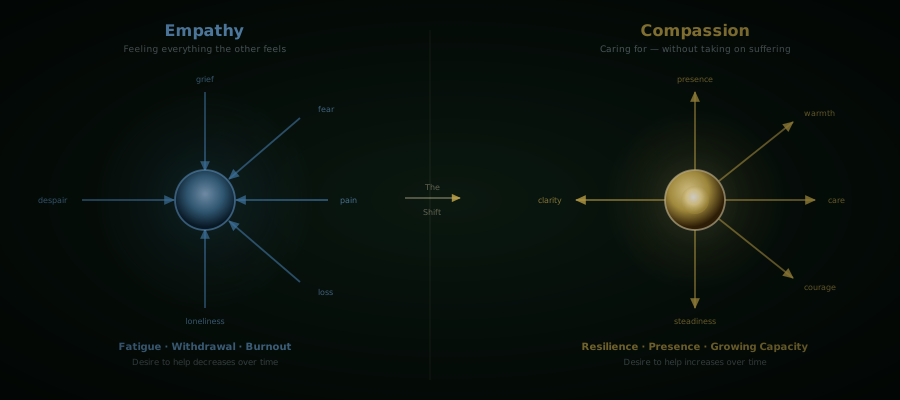
Empathy without a stable center depletes. Compassion — caring for rather than suffering with — grows the capacity to help over time.
I. Introduction — The Technology of Caring Without Collapsing
Most people who enter helping professions — medicine, social work, teaching, caregiving, nonprofit work, ministry, parenting — do so out of genuine impulse toward the good. They arrive caring. They are there because they want to be. And most of them, at some point in their career, encounter what Charles Figley at Tulane University first named in 1995 as compassion fatigue: a state of emotional depletion so complete that the original caring impulse is replaced by numbness, a protective detachment, or a cynicism that insulates the caregiver from the pain they are no longer able to stop feeling without losing themselves in it.
The conventional account of compassion fatigue treats it as the price of caring too much — as though the solution were to care less, to manage emotional distance, to learn to leave the work at work. This account is not only unhelpful; it is, the research now shows clearly, wrong.
The exhaustion that caregivers describe is not, in most cases, caused by too much compassion. It is caused by too much empathy — unmanaged empathic resonance, the sustained absorption of others' emotional states without the stabilizing ground that allows those states to be felt and released rather than accumulated and stored. Compassion and empathy are not the same thing. They are not even the same type of thing. They are different neural processes with different phenomenological signatures and, crucially, completely different trajectories for the person doing the caring.
Tanya Singer, whose work at the Max Planck Institute has become foundational in this area, draws the distinction with the precision the science demands: empathy is the resonance of another's emotional state within your own nervous system — the experience of feeling what they feel, in a way that temporarily merges your affective experience with theirs. It is automatic, pre-cognitive, and deeply human. It is also, when sustained without grounding, a direct pathway to burnout.
Compassion is different in kind, not in degree. It is not empathy with better boundaries. It is the caring response to suffering — warmth, the wish for another's wellbeing, the motivation to help — that arises from a practitioner who is genuinely present to the other's experience but not merged with it. You are moved by their pain. You do not become their pain. The distinction sounds small. Its consequences are enormous.
This chapter's thesis:
Compassion is not more empathy. It is a distinct inner technology — one that makes sustainable care possible not by reducing sensitivity but by grounding it in a stability that does not require the other's suffering to stop in order for you to remain present.
What follows is the scientific, philosophical, contemplative, and practical case for understanding compassion as precisely that: a technology. Not a temperament you were either born with or not. Not a spiritual achievement reserved for monks and mystics. A trainable human capacity with a specific structure, a documented neural substrate, a cross-cultural history spanning millennia, and — when practiced consistently — measurable effects on the wellbeing of both the practitioner and the people they care for.
II. Historical Context — The Long Science of Compassion
From Sympathy to Empathy: A Conceptual History
The word "compassion" entered the English language from the Latin compassio, itself a translation of the Greek sympatheia — to suffer with. For most of Western intellectual history, "sympathy" and "compassion" were used nearly interchangeably, both gesturing toward the human capacity to be affected by another's suffering. Adam Smith, in The Theory of Moral Sentiments (1759), placed sympathy — the imaginative capacity to place oneself in another's situation — at the center of his moral philosophy and, by extension, his economic theory. Sympathy, for Smith, was not merely pleasant; it was the foundation of the social bond, the mechanism by which human beings remain in moral relationship with one another. Without it, markets become predatory, communities dissolve, and self-interest becomes indistinguishable from violence.
The conceptual split between empathy and compassion is relatively recent and is largely a product of the cognitive and affective neuroscience of the last three decades. The word "empathy" itself was introduced in English only in 1909, as a translation of the German Einfühlung — literally, "feeling into" — coined by the philosopher Theodor Lipps to describe the projection of one's own feeling into an aesthetic object. By the mid-20th century, the term had migrated from aesthetics into psychology, where Carl Rogers deployed it as a core condition of therapeutic change: the therapist's capacity to enter the client's internal frame of reference, to feel what it is like to be this person in this moment, was, Rogers argued, not merely helpful but necessary for psychological healing.
Rogers's formulation was an enormous advance. It established empathy as a professional competency and a clinical imperative at a time when psychotherapy was still largely a matter of interpretation and analysis. But it also, inadvertently, seeded a confusion that would take decades to untangle: it implied that empathy was always good, always sustainable, always the right response. The limit of Rogers's framework was the limit of his era — there was no neuroimaging, no way to see what was happening in the brain of the therapist who was "feeling into" the client's world. We could not yet measure what that sustained resonance was costing.
The Emergence of Contemplative Neuroscience
The turning point came in the 1990s and accelerated dramatically in the 2000s with the collaboration between Western cognitive neuroscience and the Tibetan Buddhist contemplative tradition. The Dalai Lama's willingness to offer practitioners with decades of meditation experience for scientific study — and Richard Davidson's willingness to take those practitioners seriously as research subjects — produced a genuinely new field: contemplative neuroscience.
What Davidson and his colleagues at the University of Wisconsin-Madison's Center for Healthy Minds found, in study after study through the 2000s, was that the brains of experienced meditators differed from those of novices in ways that were not subtle. Long-term practitioners showed greater gray matter density in regions associated with emotional regulation, attention, and self-awareness. They showed dramatically elevated gamma wave activity during compassion meditation — a neural signature associated with heightened integration across large-scale brain networks. And they showed a consistent asymmetry in prefrontal cortex activation — greater left-side activation, associated with positive affect and approach motivation — that had previously been thought to be largely fixed in adults. The meditators' brains had been changed by practice. Not metaphorically. Structurally.
The implications were significant: if neural structure could be altered by compassion practice, then compassion was not merely a feeling or a virtue but a capacity — something that could be trained, measured, developed, and depleted. This framing — compassion as capacity — opened the door to the neuroscience that would eventually allow Singer and Klimecki to make the empathy/compassion distinction with precision.
Singer's ReSource Project: The Defining Studies
Tanya Singer's career arc follows the logic of a scientist who took a finding seriously enough to pursue it for two decades. Her 2004 Science paper — the study of N.N. and her partner — was the first direct neuroimaging evidence of the distinction between shared pain and sensory pain simulation. It established the neural substrate of empathy: the anterior insula and anterior cingulate cortex as the locus of affective resonance with another's suffering.
But the 2004 study raised a question it did not answer: if empathy activates the emotional substrate of pain, what does that do to the person experiencing it? Is sustained empathic resonance depleting or enriching? And is there an alternative neural state that produces the same caring response without the same affective cost?
Singer's answer to these questions came out of her decade-long ReSource Project, a systematic longitudinal study of the effects of different contemplative practices on the brain, body, and psychological wellbeing. The key finding, published with Olga Klimecki in Cerebral Cortex in 2013, compared what happened to participants trained in empathy practices versus those trained in compassion practices over a period of weeks.
The results were unambiguous. Participants in the empathy training condition showed increasing activation in the neural correlates of pain and negative affect — the same anterior insula and cingulate circuits — and reported increasing distress, secondary trauma symptoms, and decreased willingness to engage with suffering over the course of the study. Participants in the compassion training condition — who practiced loving-kindness and compassion meditation, cultivating warm concern and the wish for another's wellbeing — showed increasing activation in circuits associated with positive affect, affiliation, and reward (including the medial orbitofrontal cortex and the ventral striatum), and reported increasing warmth, prosocial motivation, and willingness to engage. The neural signature of compassion is not the neural signature of empathy with the volume turned down. It is a qualitatively different brain state.
Singer and Klimecki also documented an additional finding that has become widely cited in clinical training contexts: empathy training without compassion training produced emotional contagion that persisted after the training session ended. Compassion training produced something closer to what the Buddhists call equanimity — the capacity to remain emotionally warm and engaged without being dysregulated by the engagement. The practitioners were not less moved. They were differently moved — moved in a direction that sustained them rather than depleted them.
III. Empathy vs. Compassion — The Neural Distinction in Full
What Empathy Actually Is
Empathy, in its neurological sense, is a resonance process. Mirror neuron systems — first documented in macaques by Giacomo Rizzolatti at the University of Parma in the early 1990s, and later extensively mapped in humans — provide one substrate: they activate when we observe another's action or expression in a way that partially simulates that action or expression in our own motor and emotional systems. We see someone grimace in pain, and a subset of the neural circuits that would produce a grimace in us activate. We watch someone lift a heavy object, and our motor system partially rehearses the lift. This mirroring is automatic, pre-cognitive, and appears to be a foundational mechanism of social cognition.
Affective empathy builds on this substrate but is distinct from it: it involves the actual experience of a resonant emotional state, not merely its motor simulation. When N.N.'s anterior insula activated in response to her partner's anticipated pain, she was not merely cognitively representing his distress. She was, in a measurable sense, distressed. The emotional contagion that Singer and Klimecki documented in empathy-trained participants is the clinical expression of this mechanism operating without a stabilizing counterweight.
This is not a failure of empathy. It is a feature of it. Affective resonance is how we know, at a non-conceptual level, what another person is experiencing. It is the biological basis of the felt sense that another's pain matters — not merely as information, but as reality. Without empathic resonance, the suffering of others would be an abstract fact, not a lived encounter. The problem is not the resonance. It is the absence of what prevents it from becoming indistinguishable from one's own suffering.
What Compassion Is, Precisely
Compassion is not empathy plus willpower. It is not the achievement of empathy through better self-management. It is a distinct motivational and affective state with its own neural substrate.
Where empathy's signature is in the anterior insula and cingulate (pain/negative affect circuits), compassion's signature is in the medial orbitofrontal cortex, ventral striatum, and putamen (reward, affiliation, and approach circuits). The phenomenological difference matches the neural one: empathy feels like being impacted, invaded, overwhelmed; compassion feels like warmth, care, the wish to help — an approach state rather than a flinch state.
This is why the Tibetan word most often translated as "compassion" — snying rje, literally "noble heart" or "heart nobility" — has an entirely different valence from the English "empathy." It does not mean the suffering of resonating with another's pain. It means the clear, warm, energized state of one whose heart is open to the reality of another's situation without being consumed by it. And why the Sanskrit karuṇā, often translated as compassion, derives from a root meaning "to do action" — compassion, in the Buddhist understanding, is inherently active, inherently oriented toward relief. It is not a passive feeling state. It is a motivated orientation.
The Caregiver's Trajectory: Two Different Futures
The practical consequence of this neural distinction is a fork in the road for anyone who spends significant time in contact with suffering. The empathy road leads, over time, through a characteristic sequence: resonance, overextension, numbness, withdrawal. Figley's compassion fatigue framework documents this sequence in detail: the caregiver who absorbs the emotional content of others' trauma without adequate stabilization develops secondary traumatic stress — intrusive thoughts, emotional constriction, hypervigilance, and eventually the defensive numbing that looks from the outside like professional cynicism but is from the inside a form of protective dissociation.
The compassion road leads somewhere different. Davidson's research on experienced meditators showed not only that they could engage with suffering without being destabilized by it, but that the engagement itself was associated with what the data described as a kind of joyful exertion — the neural signature of effort that does not deplete, presence that energizes. This is precisely the state that caregivers in flourishing late careers describe and that caregivers in early burnout have lost access to: not the absence of feeling, but feeling that is grounded, clear, and still.
The distinction is not character. It is not that good caregivers are naturally more resilient. It is that one neural pathway is being exercised and the other is not — and the choice of which to practice is genuinely available.
IV. Self-Compassion — The Inner Foundation
Kristin Neff and the Architecture of Self-Compassion
The most counterintuitive finding in two decades of compassion research did not come from neuroimaging. It came from a psychologist at the University of Texas at Austin who turned the lens inward and asked: what happens when we apply the structure of compassion to ourselves?
Kristin Neff, whose 2003 paper in Self and Identity introduced the construct of self-compassion and developed the Self-Compassion Scale that has since been used in hundreds of studies worldwide, identified three components that together constitute what she calls the self-compassion stance:
Mindfulness — the capacity to observe your own inner experience, including pain, fear, failure, and inadequacy, with clarity and without either suppression or exaggeration. You cannot respond compassionately to what you cannot see. The person who immediately deflects from their own suffering, who reflexively minimizes it ("I shouldn't feel this way," "others have it worse"), is not practicing compassion — they are practicing avoidance. The person who over-identifies with their suffering, who merges with it and makes it the whole story of themselves in this moment, is not practicing compassion either — they are practicing what Neff calls "self-pity," the empathic resonance turned inward. Mindfulness holds the middle: this is happening; it is real; it is not everything.
Common humanity — the recognition that suffering, failure, inadequacy, and the gap between who you are and who you hoped to be are not signs of personal defect. They are the shared condition of being human. This element of Neff's framework is often underestimated in popular accounts, but it is structurally essential. Without it, the self-compassion posture risks becoming a solipsistic project of soothing oneself. With it, each moment of private suffering becomes a point of contact with the whole of humanity's struggling, a reminder that in your particular difficulty you are, paradoxically, least alone. This is the quality that monastic traditions encode in practices of collective confession, shared lament, and liturgies of loss: not the performance of communal suffering, but the lived recognition that the individual's pain is held within something larger.
Self-kindness — the active willingness to meet your own pain with warmth rather than judgment. Not because the pain is convenient or because you deserve it (the logic of self-punishment implies that you deserve the good and not the bad, which is false), but because it is there, and because you are the one who has to live inside it. Neff often uses the image of a good friend: if a good friend came to you and described exactly the situation you are in — the failure, the fear, the inadequacy you feel — what would you say to them? Most people, given this question, find that they would speak with warmth, perspective, and gentleness. Then Neff asks: why are you speaking to yourself differently?
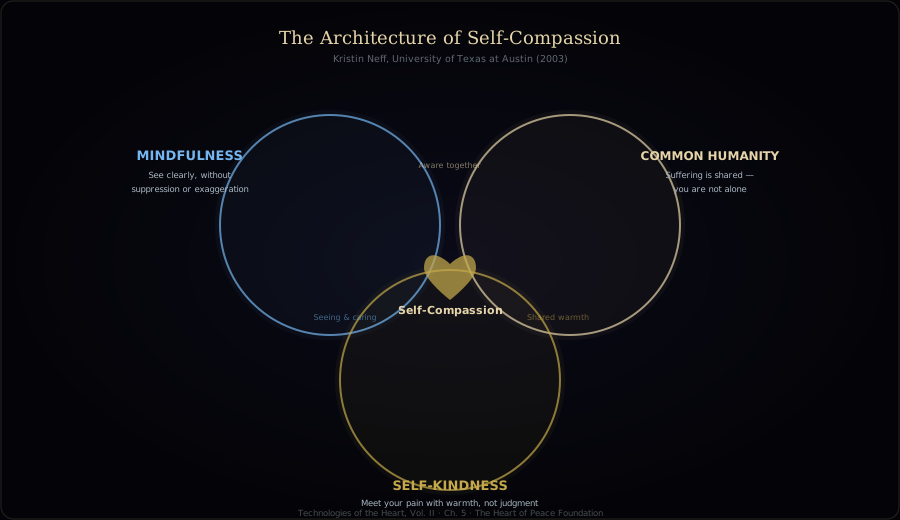
Self-Compassion vs. Self-Esteem: The Critical Distinction
Western cultures have invested heavily in the promotion of self-esteem as the psychological foundation of wellbeing, resilience, and prosocial behavior. Decades of research on self-esteem had produced a largely encouraging narrative: high self-esteem correlates with better outcomes across nearly every domain. Programs to build children's self-esteem proliferated. The problem, which took decades to fully surface, was that many of the correlates of high self-esteem were not downstream of self-esteem per se but of the contingencies on which it rested.
Self-esteem is performance-dependent. It rises when we succeed, feel attractive, feel admired, receive validation. It falls when we fail, feel diminished, feel rejected, receive criticism. This means that self-esteem is a fair-weather resource — readily available when conditions are favorable and precisely unavailable when it is most needed: when we have failed, when we are struggling, when the inner critic is loudest.
Self-compassion is unconditional. It does not rise and fall with performance. It is not a reward for doing well. It is the capacity to meet your own experience with warmth regardless of what that experience contains. This makes it, in Neff's data and in subsequent replication studies across multiple countries and cultures, a more reliable predictor of wellbeing than self-esteem. In a comprehensive meta-analysis covering over 13,000 participants, self-compassion predicted lower depression, anxiety, stress, and shame and higher life satisfaction, emotional resilience, and positive affect — and it did so more consistently than self-esteem across conditions of both success and failure.
The finding that matters most for our purposes: people with higher self-compassion consistently show more capacity for compassion toward others, not less. The fear that self-care is a zero-sum subtraction from other-care — that if you are kind to yourself you have less kindness available for the world — is not merely unsupported by the data. It is contradicted by it. Self-compassion is the infrastructure of other-compassion. It is not the alternative to caring for others. It is what makes caring for others possible to sustain.
Mindful Self-Compassion: From Research to Practice
In 2013, Neff and her collaborator Christopher Germer at Harvard Medical School published the results of the Mindful Self-Compassion (MSC) program: an 8-week structured intervention based on the three components of self-compassion, delivered in a group format. The results were significant across every primary outcome measure: participants showed significant reductions in depression, anxiety, stress, and compassion fatigue, and significant increases in compassion satisfaction, subjective wellbeing, and mindfulness. The effects were maintained at one-year follow-up.
The MSC program does not teach people to think more positively about themselves. It teaches a specific set of practices — meditations, writing exercises, and relational skills — that train the capacity to meet one's own experience with warmth, perspective, and equanimity. The outcome is not the elimination of self-criticism (which is itself a form of self-critical perfectionism — "I should be more self-compassionate") but the gradual loosening of its grip and the development of an interior resource that is available in exactly the moments when external conditions provide no support.
V. Cross-Cultural Lineages — Buddhist Karuna, Sufi Rahma, Christian Agape
The Four Brahmaviharas: The Oldest Systematic Training
The most sophisticated pre-modern analysis of compassion's structure — and its sustainable practice — is the Buddhist doctrine of the four brahmaviharas, or "divine abodes": mettā (loving-kindness), karuṇā (compassion), muditā (empathic joy), and upekkhā (equanimity). These four qualities are not a ladder to be climbed or a sequence to be completed. They are a set of mutually sustaining orientations that, together, constitute the full landscape of awakened care.
Karuṇā, compassion, is specifically defined in the Pali canon as the wish for another's suffering to cease and the motivating orientation toward its relief. It is distinguished carefully from pāli — the pain of grief or mere empathic suffering — by its clarity and its directionality. Compassion is not about feeling bad about another's suffering. It is about being moved toward their relief.
But the four brahmaviharas are taught together for a reason that the Buddhist tradition understood with extraordinary precision: karuṇā without upekkhā is unsustainable. Compassion without equanimity collapses into empathic distress — the same state that Singer and Klimecki documented in their empathy-trained participants. The meditator who opens to the suffering of the world without the stabilizing quality of equanimity is not experiencing compassion; they are experiencing what the Pali texts call dukkha-saha-gatā karuṇā — compassion accompanied by suffering, which is the near-enemy of genuine compassion. It looks like care. It depletes like drowning.
The traditional practice of the brahmaviharas begins with mettā — loving-kindness — because the unconditional warmth of lovingkindness provides the affective ground from which genuine compassion can operate without collapsing. You cannot practice compassion sustainably from a ground of fear, resentment, or self-depletion. You can practice it sustainably from the ground of warmth — and the mettā practice builds that ground systematically, beginning with the easiest object (a beloved person or a benefactor), moving through neutral persons, difficult persons, and ultimately all beings.
Tonglen: The Practice of Breathing in Suffering
Perhaps the most direct contemplative technology for training the compassion/empathy distinction is the Tibetan practice of tonglen (from gtong len — giving and taking). In tonglen, the practitioner deliberately breathes in the suffering, pain, and difficulty of a specific person or of beings generally — visualized as dark, heavy smoke entering with the inhale — and breathes out ease, relief, and spaciousness to that same person or beings, visualized as clear light. The practice is then extended until the practitioner is breathing in all suffering in the world and breathing out all relief.
This sounds, at first encounter, like a recipe for the worst possible outcome: intentionally taking on more suffering rather than less. But the logic of tonglen is precise and has been confirmed, at least structurally, by the neuroscience. The practice trains the meditator to turn toward suffering rather than away from it — to develop what the tradition calls "the warrior's heart," the capacity to remain present to reality as it is rather than as one wishes it to be — while maintaining the clarity and stability that allow that presence to be useful rather than destabilizing. The exhale — the offering of relief — is not incidental. It maintains the directionality of compassion: toward relief, toward the other's wellbeing, toward what is possible.
Joan Halifax at Upaya Zen Center, who has applied tonglen and related practices in hospice care, prison chaplaincy, and trauma support contexts, speaks of "strong back, soft front" as the embodied expression of compassion: the erect, grounded, stable spine that allows the open, vulnerable, tender front to remain open without collapsing. Strong back, soft front: the posture of compassion, literally.
Sufi Rahma: Compassion as the Nature of Reality
In the Islamic tradition — and particularly in the Sufi contemplative lineages — compassion is not primarily a human practice or a moral achievement. It is the fundamental quality of reality itself.
Every chapter of the Quran begins with Bismillah ir-Rahman ir-Rahim — "In the name of God, the Tender-Merciful, the Compassionately-Sustaining." Both ar-Rahman and ar-Rahim derive from the same root: rahm, meaning "womb." The divine names do not translate easily into English, because the kind of compassion they invoke is not primarily emotional — it is ontological. ar-Rahman refers to the universal, all-encompassing mercy that extends to all creation, believer and unbeliever alike, because it is the nature of the source from which all creation flows. ar-Rahim refers to the specific, intimate compassion that sustains and nourishes particular beings in their particular circumstances. Together, they name compassion as both the universal ground and the individual presence — the ambient condition of existence and its most intimate expression.
For the Sufi tradition, the practice of compassion is not the cultivation of a virtue but the removal of the veils that obscure one's own compassionate nature. The Sufi teacher Al-Ghazali wrote in the 11th century that rahma is not something the human being does but something they participate in when they are clear enough to do so — when the ego's contractions, its defenses, its demands for its own comfort, are sufficiently dissolved to allow the underlying current of compassion to flow through the particular form of this particular person. Practice, in this reading, is not the addition of compassion to a self that lacks it. It is the uncovering of what was always already there.
Christian Agape: The Love That Gives Without Calculation
The Christian tradition distinguishes three types of love that the English word flattens: eros (the love of desire, of wanting to possess what is beautiful), philia (the love of friendship, of mutual regard and delight), and agape (the love that gives without calculation, that seeks the flourishing of the other regardless of what it costs the self). It is agape that the New Testament characteristically invokes in the context of compassion — not the emotion of warmth (though that may be present) but the orientation of the will toward another's good.
The distinction is practical, not merely theological. Agape is not contingent on the other's lovability. It is not empathic resonance. It is not the feeling of warmth. It can be present in the absence of all of those, and it can be absent when all of those are present in high degree. The person who rushes in to fix another's suffering out of their own discomfort with the suffering — who "helps" in ways that primarily serve their own need to stop witnessing pain — is experiencing empathic resonance. The person who remains with another in their suffering, who offers what is genuinely needed rather than what feels most relieving to the helper, who does not require the suffering to stop in order to remain present — that person is practicing something closer to agape.
Thomas Aquinas, in the Summa Theologiae, defined the virtue of compassion (misericordia, literally "sorrowful heart") as the grief of the heart at the misery of another, with the desire to relieve it. The grief is real — not performed, not suppressed. The desire to relieve is real — not passive, not resigned. The combination is what makes it a virtue: not merely a feeling, but a feeling that is directed, stable, and productive.
VI. Equanimity as the Ground of Care
The Philosophical Depth of the Distinction
The empathy/compassion distinction maps, at the philosophical level, onto one of the oldest questions in Western ethics: how is it possible to be genuinely responsive to the suffering of another without being destabilized by it? The Stoic tradition answered this question with an emphasis on apatheia — not "apathy" in the modern pejorative sense, but the freedom from being ruled by the passions, the capacity to perceive clearly and respond wisely without being swept away by whatever is happening. The Stoics were sometimes misread as advocating for emotional coldness. What they were actually arguing for was something much closer to equanimity: the stability that allows full perception without loss of agency.
Aristotle's phronesis — practical wisdom, the capacity to discern the right response in a particular situation — requires something similar. The person who is overwhelmed by emotion in a crisis cannot exercise phronesis: the emotional flooding reduces the cognitive bandwidth needed for wise discernment. But the person who is emotionally disconnected from a situation also cannot exercise phronesis: they lack the affective information that tells them what matters, what is urgent, what kind of response the situation calls for. Phronesis operates in the space between flooding and disconnection — the space that compassion practice, at its best, cultivates.
Joan Halifax's Edge States
Joan Halifax's framework of "edge states" maps this territory with clinical precision. Edge states are the qualities of character and practice that define excellent caregiving — compassion, empathy, altruism, integrity, and respect — and that also, when pushed past their sustainable threshold, tip into their pathological inversions. Compassion becomes compassion fatigue. Empathy becomes empathic distress. Altruism becomes martyrdom. Integrity becomes moral rigidity. Respect becomes submission.
Halifax's insight is that the tipping point is not the quantity of the quality but the presence or absence of its stabilizing counterpart. Compassion without equanimity tips. Compassion grounded in equanimity does not — or if it does, it recovers quickly. The stabilizer is not detachment. It is the capacity to hold what one is feeling within a larger context that does not require resolution in order to allow presence.
This is what Halifax means by "strong back, soft front" — the erect spine of equanimity, the open chest of compassion. Not one without the other. Both, simultaneously. The spine does not close the front. The open front does not collapse the spine. The two make each other possible.
Charles Raison and the Immunology of Compassion
If the philosophical and neuroscientific cases for compassion as distinct from empathy were not sufficient, the immunological evidence from Charles Raison at the University of Arizona provides a striking additional dimension. Raison's research demonstrated that compassion practices — specifically loving-kindness meditation — reduce inflammatory markers, including C-reactive protein (CRP) and interleukin-6 (IL-6), that are elevated under conditions of chronic psychological stress and are associated with increased risk for depression, cardiovascular disease, and immune dysregulation.
What this means, translated: the biological cost of chronic empathic distress is not merely psychological. It is immunological. Sustained empathic overextension — the caregiver who is chronically merged with others' suffering — shows physiological markers that predict illness. The compassion-practicing caregiver shows markers that predict health. Compassion is not a spiritual luxury. It is a biological necessity for anyone whose work involves sustained contact with human suffering.
VII. Practical Application — Cultivating Compassion as Daily Practice
Paul Gilbert's Compassion-Focused Therapy
Paul Gilbert at the University of Derby developed Compassion-Focused Therapy (CFT) specifically for a population that had been systematically undertreated by standard cognitive-behavioral approaches: people with high shame, high self-criticism, and the characteristic self-attacking inner voice that says, in various registers, that they are fundamentally defective and deserve their suffering.
Gilbert's model rests on a tripartite framework of emotional regulation systems. The threat system — the oldest evolutionary system — detects danger and mobilizes the fight-flight-freeze responses necessary for immediate survival. The drive system detects reward and activates the dopaminergic circuits that produce approach behavior, motivation, and the experience of striving. The contentment/soothing system — the newest evolutionary system, tied to mammalian attachment — is activated by safety, warmth, affection, and genuine care, and produces the felt sense of being held, settled, and at peace.
The problem for people with high shame and self-criticism is that the threat system is chronically over-activated by their own self-critical inner voice — the voice is experienced as a threat, and produces the same physiological responses as an external threat would. The drive system, meanwhile, is often hijacked by perfectionism — always striving, never arriving. The soothing system, which could provide the stabilizing counterweight, is underdeveloped or entirely distrusted: such people often feel deeply uncomfortable receiving warmth, care, or compassion because it was associated with danger in their developmental history.
CFT's intervention is to deliberately activate the soothing system — through compassion practices, through the development of a "compassionate self" that can observe the inner critic without identifying with it, through guided imagery exercises that train the neural circuits of warmth and care the way any other capacity is trained: through repeated practice. The results across multiple randomized controlled trials show significant reductions in depression, self-harm, and shame, and significant increases in self-compassion, emotional regulation, and overall wellbeing. Gilbert's work makes particularly clear that self-compassion is not a soft skill — it is a clinical intervention with measurable efficacy for some of the most treatment-resistant presentations in modern psychiatry.
Try This Today
There is a practice from the Buddhist tradition that takes no special equipment, requires no quiet room, and can be done anywhere. It is sometimes called metta — the cultivation of loving-kindness — and its basic form has three steps.
Bring to mind someone you care about who is currently struggling. Not to fix their situation, not to rehearse what you would say to them, not to worry on their behalf. Simply to hold them in awareness with warmth — to let the fact of their difficulty genuinely matter to you, and from that place of genuine mattering, to spend thirty seconds wishing them well. Not wishing their problem away. Wishing them well: ease in their body, clarity in their mind, the felt sense of being accompanied rather than alone.
Then extend that same wish to yourself. Right now. Whatever you are carrying. Whatever gap exists between where you are and where you hoped to be. For thirty seconds, offer yourself the same warmth you just offered to the person you care about.
Then ask yourself: what, if anything, can I genuinely offer to the person I had in mind?
Notice the quality of what arises from that question when it is asked from groundedness rather than from guilt, fear, or the need to fix.
This is the structure of compassion in practice: seeing clearly, being genuinely moved, remaining grounded, acting from care. Twenty-four words. A lifetime of practice. And, as the research consistently shows, a measurably different brain state from the one you were in before you started.
VIII. The Maslow Compass and Compassion
Reading the Compass Through Empathy and Compassion
The Maslow Compass — available at /tools/maslow-compass and developed as a companion tool to the Hourglass of Being framework explored in Chapter 8 — maps seven dimensions of human flourishing, each of which can be oriented upward (nourishing, generative, alive) or downward (depleting, reactive, contracted). Compassion is not one dimension among the seven. It is the quality of attention that determines, moment to moment, which direction the energy in the emotional and relational dimensions flows.
When you check in with the compass and find yourself in the emotional dimension — asking how you are doing at the level of feeling, relating, and inner life — the empathy/compassion distinction shows up with diagnostic clarity. The empathic (reactive, merged) state in the emotional dimension looks like: absorbed in others' feelings to the detriment of your own stability, difficulty distinguishing your distress from someone else's, the sense that you cannot be at peace until the people around you are at peace, caring that is experienced as obligation rather than choice. This is not a moral failure. It is a downward orientation in the emotional dimension — one in which the energy is moving toward contraction, reactivity, and depletion.
The compassionate (grounded, clear) state in the same dimension looks like: genuinely moved by others' experiences without losing the thread of your own, capable of caring that renews rather than depletes, the sense that your stability is a gift to the people around you rather than an indifference to them. This is the upward orientation — energy moving toward nourishment, presence, and sustainable engagement. The compass is a tool for recognizing, in real time, which state you are in — not to judge the downward orientation but to understand it, and to know what practices are available to shift the direction.
Self-Compassion and the Inner Wisdom Dimension
Neff's three components of self-compassion — mindfulness, common humanity, and self-kindness — map with striking precision onto what the hourglass model calls the inner wisdom dimension: the dimension of self-knowledge, reflective capacity, and the discerning relationship to one's own inner life.
Mindfulness is the basic competency of the inner wisdom dimension: the capacity to observe what is actually happening in your own experience, without the distortions of suppression, exaggeration, or identification. Common humanity is the relational quality that prevents inner wisdom from becoming narcissistic self-absorption: the recognition that what you find in your own interior, including its darkness and difficulty, connects you to the whole rather than isolating you within it. Self-kindness is the motivational quality that allows inner wisdom to be productive rather than punitive: the willingness to use what you discover about yourself in service of growth rather than self-condemnation.
Together, these three components describe an inner wisdom dimension that is oriented upward — toward nourishment, learning, and the development of genuine capability — rather than downward toward self-criticism, shame, and the paralysis of chronic inadequacy. The daily compass check-in invites you to assess this dimension honestly: am I relating to my own inner experience with clarity and warmth, or with suppression and judgment? The answer is actionable. The self-compassion practices described by Neff and Germer — the self-compassion pause, the loving-kindness meditation, the practice of speaking to yourself as you would speak to a good friend — are the upward-orienting interventions for this dimension.
Recognizing the Slip from Compassion to Empathic Overextension
The most practically useful function of the compass, in the context of compassion practice, is its capacity to help you recognize the moment when you have moved from compassionate engagement to empathic overextension — before the overextension has progressed far enough to require a full recovery.
The early signs are specific: you begin to feel that your own wellbeing is contingent on the wellbeing of the person you are caring for; you find it difficult to leave the caring situation (a conversation, a relationship, a role) without lingering distress; you begin to experience the other's suffering as a demand rather than a reality; you notice resentment appearing at the edges of what was genuine care. These are not signs that you have become a bad caregiver. They are signals from the nervous system that the soothing/compassion circuit has been asked to operate beyond its current capacity, and that the threat and empathy circuits have taken over the territory.
The compass check-in at this moment is not a performance review. It is a diagnostic: where is the energy moving? What direction is the care oriented? What does this moment require? And the intervention is usually simple: a pause, a breath, a moment of metta toward yourself — the recognition that you are carrying something, and that you are allowed to put it down long enough to remember that you are not it. Then, from that ground, returning to the care. Not because you have to. Because you genuinely want to.
IX. Integration with the Technologies of the Heart
The Technologies of the Heart series maps ten distinct capacities — each of which is a practice, a neural substrate, a cultural lineage, and a lived skill — that together constitute what we might call the full toolkit of human flourishing. Compassion does not sit quietly in its own chapter. It runs through all of them, because caring that is genuinely useful requires the inner stability that only compassion provides. Here is how that integration works across the full series:
Chapter 1 — Generosity: Compassion is the inner face of generosity — the capacity to be genuinely moved by another's need without losing yourself in it. Without compassion, generosity has two problematic trajectories: it becomes either performative (giving that is primarily about the giver's self-image) or depleting (giving that is driven by empathic distress, that cannot sustain itself over time because it is powered by pain rather than care). Compassion grounds generosity in a stable warmth that makes the act of giving a source of renewal rather than expenditure.
Chapter 2 — The Golden Rule: The Golden Rule — treat others as you would wish to be treated — provides the ethical structure of reciprocal regard. But it requires content: you have to know, in a felt way, what the other needs. Compassion supplies that felt knowledge. It is the experiential content that fills the ethical structure, the capacity to sense, not merely infer, what genuine care looks like in this particular situation for this particular person.
Chapter 3 — Paying It Forward: Sustainable paying-it-forward — the forward chain of care and generosity described in Chapter 3 — is powered, at the individual level, by self-compassion. The caregiver who cannot receive care cannot give it indefinitely. The person who insists on never being the one who needs anything eventually runs dry. Self-compassion is the mechanism by which the giver remains within the circle of care — not only extending it outward but capable of receiving when reception is what keeps the chain alive.
Chapter 4 — Collaboration: Collaboration requires genuine encounter — the willingness to be actually affected by another's perspective, another's reality, another's presence. This is impossible without some form of empathic resonance. But it is unsustainable without the compassionate stability that prevents resonance from becoming merging. Genuine collaboration — the kind that produces outcomes greater than the sum of its parts — requires participants who can remain genuinely themselves (bring their own perspective, their own knowledge, their own resistance when resistance is appropriate) while remaining genuinely open to the other. This is precisely the capacity that compassion practice develops.
Chapter 6 — Oneness: Oneness — the recognition that the separation between self and other is less absolute than ordinary consciousness assumes — is the philosophical and experiential territory of Chapter 6. Compassion is the felt sense of what that recognition means in practice. It is the moment when the boundary between self and other becomes permeable enough to feel what is real for the other without dissolving into it — the living experience of non-separation that is different from both merger (empathic flooding) and distance (defensive separation). Compassion is, in this reading, not a preparation for the experience of Oneness but an instantiation of it: the moment when care flows across the apparent gap without erasing the gap entirely.
Chapter 7 — The Toroidal Economy: The toroidal economy described in Chapter 7 — the model of giving and receiving that circulates rather than depletes, that is powered by the quality of attention rather than the quantity of resources — depends on compassion as the quality of attention that keeps the torus alive. Where compassion fails, the economy of care becomes extractive: the giver depletes in one direction, the receiver becomes passive in another, and the circulation stops. Where compassion is present — stable, warm, genuinely motivated by the other's flourishing rather than the self's discomfort or self-image — the torus maintains its motion.
Chapter 8 — The Hourglass of Being: In the hourglass model, the emotional dimension is one of seven simultaneously active dimensions. Compassion determines the orientation of that dimension: upward (nourishing, generative, genuinely present to others from a ground of inner stability) or downward (depleting, reactive, contracted). As discussed in Section VIII, the empathy/compassion distinction maps directly onto the upward/downward distinction that the hourglass uses to describe the emotional dimension's orientation. Compassion is the practice that keeps the emotional dimension moving upward.
Chapter 9 — Intention, Motivation, and Purpose: The IMP framework (Intention, Motivation, Purpose) that structures Chapter 9 rests on the insight that the same action can have entirely different effects — on the giver, on the receiver, and on the relationship between them — depending on the quality of motivation from which it arises. Compassion supplies the motivation that makes the intention pure: not the fear of another's disapproval, not the discomfort of witnessing unresolved suffering, not the performative goodness that requires an audience — but the intrinsic motivation to contribute to another's genuine wellbeing that is recognizable, and received, as fundamentally different.
Chapter 10 — The Generosity Standard: The Generosity Standard — the aspiration to make generosity the organizing principle of a life, a community, or an institution rather than a supplement to it — rests ultimately on the willingness to extend oneself for another's good without requiring equivalent return. This extension is possible, sustainably, only from the ground that compassion provides. It is compassion that makes the Generosity Standard something other than a demand for self-sacrifice. When the act of extending oneself genuinely arises from warmth, from care, from the living sense that another's flourishing contributes to your own, the extension does not deplete. It renews.
Why This Matters:
The scale of suffering in the world at this moment — human suffering, ecological suffering, the suffering embedded in systems built on extraction and exclusion — can produce one of two responses in people who are paying attention: numbness or overwhelm. Neither is useful. Both are understandable. Both are, in different ways, empathic responses to a reality too large to take in.
What the world most needs from those who care is not more empathy. It is more compassion — the grounded, stable, clear-seeing capacity to remain present to suffering without being consumed by it, and to act from care without being paralyzed by the gap between what is and what should be. This is not cold. It is precisely the opposite. It is the most fully alive possible response to the reality we are in. And it is learnable.
X. Conclusion — Back to the Scanner
Return, for a moment, to the scanner. To N.N. To the woman lying inside a large magnetic tube while her partner lay in an adjacent room, connected to electrodes, about to feel pain. To the moment when the scan showed that her anterior insula activated when his pain was anticipated, activated again when it arrived — that the suffering registered, genuinely, in her own emotional circuitry — and that the sensory cortex remained quiet. His pain. Her care. Two bodies. One felt reality, held in the specific, structural way that is different from both merger and distance.
What N.N. was doing in that scanner, without knowing it had a name, without knowing there would be twenty years of subsequent research elaborating its neural substrate and its cross-cultural lineage and its clinical application — what she was doing was precisely what this entire chapter has been about. She was feeling without dissolving. She was present without losing herself. She was moved without being swept away.
This is what compassion looks like from the inside of an fMRI scanner. From the inside of a life, it looks like the hospice nurse who is still fully present with her tenth patient of the day. It looks like the teacher who sees the difficult child — not the behavior, but the child underneath the behavior — at the end of a long week. It looks like the parent who can hold their adolescent's storm without either absorbing it or retreating from it. It looks like the activist who can face the scale of the world's suffering without either burning out or going numb. It looks like the person at 3 a.m. who can feel what they feel, offer themselves the warmth they would offer a good friend, and return to sleep.
Compassion is not a state you achieve. It is a practice you return to. Every time you notice you have slipped from it — into the empathic flooding, into the protective withdrawal, into the self-critical loop — the return itself is the practice. The capacity is built in the returning, not in some imagined sustained perfection.
There is an old story in the Zen tradition of a student who comes to a teacher weeping. The teacher pours tea. The student says: "Why are you pouring tea when I'm in so much pain?" The teacher says: "Because you are in so much pain."
The tea is not a solution. The pouring is not a distraction. The pouring is what it looks like when someone remains present, grounded, and caring in the face of suffering they cannot fix. It looks like an ordinary, tender act — one that says, simply: I am here. I am not afraid of your pain. And I will stay.
That is compassion. It is available to every one of us. And the world we are building depends on it.
Next Steps
Continue reading: Chapter 6 — Oneness: The Ultimate Technology →
Discover the recognition that transforms everything: that separation is the original illusion, and that the deepest technology of the heart is simply the memory of what we already are.
Return to the series overview: Technologies of the Heart
Related Articles
- Chapter 1: The Art & Science of Generosity — The biological technology on which compassion builds
- Chapter 4: Collaboration — The Geometry of Flourishing — Compassion as the inner foundation of genuine collaborative capacity
- Chapter 6: Oneness — The Ultimate Technology — The recognition from which compassion naturally flows
- Chapter 7: The Toroidal Economy — The circulation of care that compassion sustains
- Chapter 8: The Hourglass of Being — The seven dimensions of flourishing that compassion orients
- Technologies of the Heart — Series Overview — All ten chapters in context
- Our Programs — Where Compassion Is Practiced — Community spaces built around compassionate presence
FAQ
What is the difference between compassion and empathy?
Empathy is the resonance of another's emotional state within your own nervous system — you feel what they feel, in a way that temporarily merges your affective experience with theirs. Compassion is the caring response to another's suffering, grounded in your own emotional stability — you are moved by their pain without being swept into it. Tanya Singer at the Max Planck Institute confirmed with neuroimaging in 2013 that the two states activate different brain circuits: empathy activates pain and negative affect circuits, while compassion activates positive affect, affiliation, and reward circuits. The practical consequence is significant: sustained empathy alone depletes and eventually leads to withdrawal, while compassion practice sustains and even increases caregiving capacity over time.
What is compassion fatigue and how do you recover from it?
Despite its name, compassion fatigue is not caused by too much compassion — it is caused by sustained empathic resonance without the stabilizing ground of compassion. Charles Figley at Tulane University, who named the condition in 1995, described it as "secondary traumatic stress": the cumulative cost of absorbing others' emotional pain without adequate inner resources to process and release it. Recovery involves, first, the recognition that the depletion is not a character defect but a physiological and psychological state produced by a specific pattern of engagement; second, the development of self-compassion practices that restore the inner stability that empathic overextension has eroded; and third, learning to shift from empathic resonance (feeling with) to compassionate engagement (caring for) as the primary mode of presence with suffering. Research by Singer and Klimecki confirmed that compassion training not only prevents compassion fatigue but reverses it in those who are already experiencing it.
What is self-compassion and how is it different from self-esteem?
Self-compassion, formalized by Kristin Neff at the University of Texas at Austin, is the practice of treating yourself with the same warmth, care, and understanding you would naturally extend to a good friend who is suffering. It has three components: mindfulness (seeing your own experience clearly without suppression or exaggeration), common humanity (recognizing that your suffering connects you to the universal human experience rather than isolating you), and self-kindness (actively meeting your own pain with warmth rather than judgment). Self-esteem, by contrast, is contingent on performance: it rises when you succeed and falls when you fail, which means it is unavailable precisely when it is most needed. Self-compassion is unconditional — it is available in failure, in difficulty, in the moments when the inner critic is loudest. Neff's research shows that self-compassion is a more reliable predictor of wellbeing, resilience, and prosocial behavior than self-esteem across diverse populations and conditions.
Can compassion be learned or trained?
Yes — and this is one of the most important findings of contemplative neuroscience over the last two decades. Richard Davidson at the University of Wisconsin-Madison documented structural brain changes — increased gray matter density in regions associated with emotional regulation, elevated gamma wave activity during compassion meditation — in long-term meditators, and showed that measurable changes in neural connectivity and prosocial behavior occur after as little as two weeks of compassion training in novices with no prior experience. Tanya Singer's ReSource Project showed that compassion training (but not empathy training alone) produces lasting increases in positive affect and prosocial motivation. Christopher Germer and Kristin Neff's Mindful Self-Compassion program showed significant improvements in wellbeing and reductions in compassion fatigue that were maintained at one-year follow-up. Compassion is not a fixed trait you either have or lack. It is a trainable capacity with a documented neural substrate.
What does neuroscience say about compassion?
Modern contemplative neuroscience has produced several convergent findings about compassion. First, compassion and empathy are neurologically distinct: compassion activates positive-affect and approach circuits (medial orbitofrontal cortex, ventral striatum) while empathy activates pain and negative-affect circuits (anterior insula, anterior cingulate cortex). Second, compassion is trainable: even brief interventions (7 hours of practice in one Davidson study) produce measurable changes in neural structure and function. Third, compassion has immunological effects: Charles Raison's research showed that loving-kindness practices reduce inflammatory markers (CRP, IL-6) associated with chronic stress and disease. Fourth, the brains of experienced compassion meditators show extraordinary integration: gamma wave synchrony during compassion practice, elevated left prefrontal activation (positive affect), and heightened connectivity between the insula (interoception) and the motor cortex (preparedness for action). Compassion in expert practitioners is not a passive feeling state but an active preparatory orientation toward the relief of suffering.
What is the Buddhist practice of tonglen?
Tonglen (from the Tibetan gtong len, "giving and taking") is a compassion practice in which the practitioner deliberately breathes in the suffering of a specific person or of beings generally — visualized as dark, heavy smoke — and breathes out relief, ease, and spaciousness to the same person or beings, visualized as clear light. The practice begins with a specific person whose suffering is close and real, then expands to include larger circles of beings. It trains the practitioner to turn toward suffering rather than away from it — to develop what the tradition calls the "warrior's heart" — while maintaining the directional clarity of compassion: always oriented toward relief. Tonglen is the direct experiential antidote to empathic collapse: instead of training the practitioner to manage their distance from suffering, it trains them to engage with suffering from a ground of such stability and warmth that the engagement itself becomes a source of strength. Joan Halifax has used tonglen extensively in hospice care and prison chaplaincy contexts, with significant documented effects on caregiver resilience and presence.
Why do helpers and caregivers burn out, and what prevents it?
Burnout in helping professions results from a specific pattern: sustained empathic resonance with others' suffering, in the absence of the stabilizing ground that compassion provides, combined with the systemic factors (overwork, lack of support, moral injury from systems that prevent effective care) that erode the inner resources needed to maintain that ground. The neural mechanism is well-documented: repeated activation of the anterior insula and cingulate pain circuits, without the counterbalancing activation of the compassion/soothing circuits, produces progressive sensitization, emotional exhaustion, and eventually the defensive numbing that clinicians call depersonalization. What prevents burnout is not caring less — the research is unambiguous on this — but caring differently: shifting from empathic resonance as the primary mode to compassionate engagement; developing self-compassion as a regular practice so that the inner resource is replenished rather than simply depleted; maintaining the equanimity that allows one's own stability to be a resource for those in one's care rather than a casualty of their need. Paul Gilbert's Compassion-Focused Therapy, Neff and Germer's Mindful Self-Compassion program, and Davidson's mindfulness-based interventions for healthcare workers all show significant efficacy for burnout prevention and recovery.
Further Reading
- Kristin Neff — Self-Compassion: The Proven Power of Being Kind to Yourself (2011) — The foundational text on self-compassion research and practice
- Tanya Singer & Matthieu Ricard (eds.) — Caring for Others Without Losing Oneself (2015) — Research from the ReSource Project distinguishing empathy from compassion in full scientific depth
- Richard Davidson & Sharon Begley — The Emotional Life of Your Brain (2012) — Neuroscience of compassion practice and neural plasticity
- Joan Halifax — Standing at the Edge: Finding Freedom Where Fear and Courage Meet (2018) — Clinical and contemplative map of the edge states of compassionate care
- Kristin Neff & Christopher Germer — The Mindful Self-Compassion Workbook (2018) — Practical, evidence-based guide to the MSC program
- Paul Gilbert — The Compassionate Mind (2009) — The foundational text on Compassion-Focused Therapy and the three emotional regulation systems
- James Doty — Into the Magic Shop: A Neurosurgeon's Quest to Discover the Mysteries of the Brain and the Secrets of the Heart (2016) — Personal and scientific exploration of compassion from the director of Stanford's CCARE
- Brené Brown — The Gifts of Imperfection (2010) — Research on the relationship between compassion, vulnerability, and the clarity that makes boundaries possible
References
- Singer, T., Seymour, B., O'Doherty, J., Kaube, H., Dolan, R. J., & Frith, C. D. (2004). Empathy for pain involves the affective but not sensory components of pain. Science, 303(5661), 1157–1162.
- Klimecki, O. M., Leiberg, S., Lamm, C., & Singer, T. (2013). Functional neural plasticity and associated changes in positive affect after compassion training. Cerebral Cortex, 23(7), 1552–1561.
- Neff, K. D. (2003). The development and validation of a scale to measure self-compassion. Self and Identity, 2(3), 223–250.
- Neff, K. D., & Germer, C. K. (2013). A pilot study and randomized controlled trial of the Mindful Self-Compassion Program. Journal of Clinical Psychology, 69(1), 28–44.
- Davidson, R. J., Kabat-Zinn, J., Schumacher, J., Rosenkranz, M., Muller, D., Santorelli, S. F., ... & Sheridan, J. F. (2003). Alterations in brain and immune function produced by mindfulness meditation. Psychosomatic Medicine, 65(4), 564–570.
- Lutz, A., Greischar, L. L., Rawlings, N. B., Ricard, M., & Davidson, R. J. (2004). Long-term meditators self-induce high-amplitude gamma synchrony during mental practice. Proceedings of the National Academy of Sciences, 101(46), 16369–16373.
- Figley, C. R. (Ed.). (1995). Compassion Fatigue: Coping with Secondary Traumatic Stress Disorder in Those Who Treat the Traumatized. Brunner/Mazel.
- Gilbert, P. (2009). Introducing compassion-focused therapy. Advances in Psychiatric Treatment, 15(3), 199–208.
- Raison, C. L., Hale, M. W., Fox, J. H., Lowry, C. A., & Lukkes, J. L. (2014). Toward a whole-body pushback on the immune system as a driver of depression. Pharmacology, Biochemistry and Behavior, 119, 18–31.
- Halifax, J. (2018). Standing at the Edge: Finding Freedom Where Fear and Courage Meet. Flatiron Books.
Glossary
Empathy: The resonance of another's emotional state within your own nervous system — the experience of feeling what another person feels in a way that temporarily merges your affective experience with theirs. Neurologically associated with the anterior insula and anterior cingulate cortex (pain and negative affect circuits). Distinct from compassion. When sustained without grounding, associated with burnout, secondary traumatic stress, and eventual emotional withdrawal.
Compassion: The caring response to another's suffering, grounded in the practitioner's own emotional stability. Neurologically associated with the medial orbitofrontal cortex, ventral striatum, and putamen (positive affect, affiliation, and approach circuits). Distinct from empathy. Activates and sustains rather than depletes caregiving capacity, and is associated with measurable improvements in both caregiver wellbeing and care quality. From the Latin compati, to suffer with; but in practice, the capacity to care for another without suffering with them in a way that dissolves your own ground.
Self-Compassion: The practice, researched and formalized by Kristin Neff at the University of Texas at Austin, of treating oneself with the same warmth, care, and understanding one would naturally extend to a good friend who is suffering. Composed of three components: mindfulness (clear, non-suppressive, non-exaggerating observation of one's own inner experience), common humanity (recognition that one's suffering connects one to the universal human condition rather than isolating one within it), and self-kindness (the active willingness to meet one's own pain with warmth rather than judgment). Unconditional, unlike self-esteem; a more reliable predictor of wellbeing and resilience across conditions of both success and failure.
Compassion Fatigue: A state of emotional and physical exhaustion arising not from compassion per se but from sustained empathic resonance without grounding — the practitioner takes on the emotional experience of others' suffering without the stabilizing capacity of compassionate presence. Named by Charles Figley at Tulane University in 1995. Recoverable through compassion training, self-compassion practice, and supervisory support. Important: it is caused by too much unmanaged empathy, not by too much compassion.
Equanimity (Upekkhā): In the contemplative traditions and in psychological research, the capacity to remain steady and present in the face of suffering — one's own or another's — without either being swept away by it or retreating from it. The fourth of the four brahmaviharas in Buddhist practice, taught in direct conjunction with compassion (karuṇā) because compassion without equanimity collapses into empathic distress. The stabilizing quality that makes compassion sustainable; not indifference, but the ground from which genuine presence becomes possible.
Tonglen (Tibetan: gtong len): A Tibetan Buddhist compassion practice in which the practitioner deliberately breathes in the suffering of specific beings and breathes out relief to those same beings. Trains the capacity to turn toward suffering rather than away from it — to engage with the reality of pain from a ground of stability and warmth — and maintains the directional clarity of compassion (always oriented toward relief). Used clinically by Joan Halifax and others in hospice care, prison chaplaincy, and trauma support contexts.
Brahmaviharas: The four "divine abodes" in Buddhist contemplative practice: mettā (loving-kindness), karuṇā (compassion), muditā (empathic joy), and upekkhā (equanimity). Taught together because they are mutually sustaining orientations: compassion without loving-kindness has no warm ground to operate from; compassion without equanimity tips into empathic distress; equanimity without compassion tips into indifference. The oldest formal training in the distinction between compassion and empathy, developed over 2,500 years before modern neuroscience named the difference.
The Heart of Peace Foundation cultivates compassion, generosity, and human flourishing through mindfulness, community nourishment, and spiritual growth. Explore our programs or get involved to bring these technologies into your community.