Oneness — The Ultimate Technology
Technologies of the Heart — Volume II, Chapter 6
Part of the Technologies of the Heart series | The Heart of Peace Foundation
← Chapter 5 — Compassion as Inner Clarity | Next: Chapter 7 — The Toroidal Economy →
On February 20, 1962, astronaut John Glenn became the first American to orbit the Earth. He had prepared for everything: the launch vibrations, the blackout of communication, the mechanical checklists that would occupy every minute of a controlled six-hour mission. He had not prepared for what happened when he looked out the capsule window.
The terminator — the line between day and night — was moving across the African continent below him. The Sahara was a warm ochre crescent. The Atlantic was a dark field stitched with light. And something happened that no amount of astronaut training had described: the distinction between himself and what he was seeing temporarily ceased to make sense. Not in a way that was frightening. In a way that felt more real than any perception he had experienced on the ground. He later said that he had wanted to take that feeling back and put it in a bottle — to hand it to every world leader, every person nursing a grievance, every family torn apart by an argument about a boundary line.
What Glenn experienced was not unique to him. Of the roughly 600 people who have traveled to space, a remarkably consistent percentage — documented by philosopher Frank White in his 1987 study The Overview Effect — describe a variant of the same structural shift: the sudden recognition, made available by seeing the Earth from outside it, that the divisions we take to be fundamental — between nations, species, self and world — are features of a particular perceptual scale, not ultimate truths about the structure of reality. The planet, seen whole, is a single living system. And the person looking at it is not outside that system looking in. They are the system looking at itself.
This is not a feeling that comes only from orbit. It arrives in childbirth and in grief, in the first moment of genuine forgiveness, in the forest at dusk, in the seconds after a piece of music resolves in a way that feels inevitable. It arrives, with systematic regularity, in the long practices of every contemplative tradition on Earth — and it has been arriving, quietly, at the edges of physics and neuroscience for the past century.
This chapter is about what arrives. What it is. Why it matters. And — most critically — how it changes what is possible.
What this article reveals:
- Oneness is not a mystical belief but a description — the most precise account available of what reality actually is at the level at which physics, neuroscience, and contemplative science converge
- The boundary between self and world is constructed by the brain — specifically by the posterior parietal cortex — and that construction, while useful, is incomplete; its quieting, measurable in SPECT imaging, correlates directly with the phenomenological experience of non-duality
- David Bohm's implicate order is not a metaphor for oneness; it is a rigorous scientific proposition grounded in quantum entanglement, proposing that the apparent separateness of things is a secondary feature of a deeper undivided wholeness
- The five previous technologies in this series — generosity, the Golden Rule, paying it forward, collaboration, and compassion — each become structurally easier and more sustainable when grounded in the lived recognition that self and other are not ultimately separate
- Advaita Vedanta, Sufism, Buddhism, Indigenous cosmologies, and Christian mysticism have been describing the same structural recognition for millennia — from different directions, in different languages, with different practices, but converging on the same central claim
- The self-transcendence dimension of the Maslow Compass — the apex Maslow himself added in 1969 but the standard pyramid almost universally omits — is precisely this recognition: that the self actualizes itself only to the extent it recognizes it was never only itself
- The conclusion of this chapter is not an argument to be accepted but an experience to be inhabited: the aliveness you feel reading this — the sense of something being recognized rather than merely learned — is the technology already working
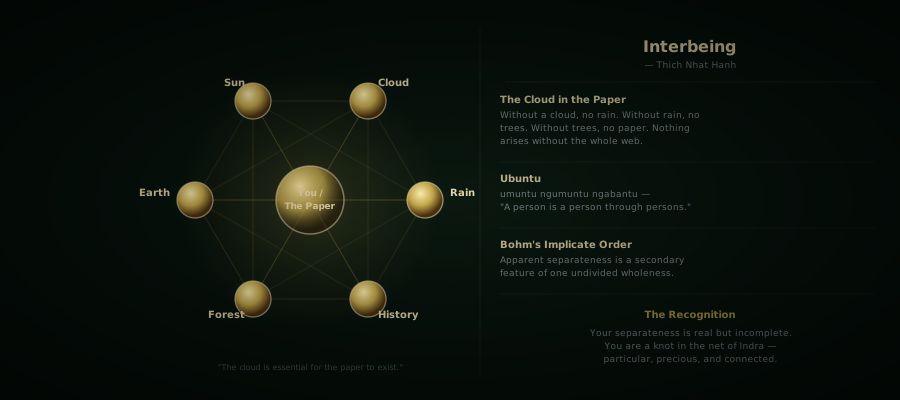 Thich Nhat Hanh's interbeing made visible: the cloud is in the paper. Nothing arises without the whole web of conditions that produced it.
I. Introduction — The Recognition That Changes Everything
Each chapter in this series has explored a distinct technology of the heart: generosity, the Golden Rule, paying it forward, collaboration, compassion. These are not random selections. They form a sequence — a progressive deepening — in which each successive technology requires, as its foundation, something that the previous ones begin to make available. Generosity becomes more natural when it is grounded in the Golden Rule. The Golden Rule becomes more natural when one has practiced paying it forward. Paying it forward makes new sense in the context of genuine collaboration. And compassion — the capacity to remain present to suffering without collapsing into it — is the inner technology that makes all of them sustainable.
But there is something underneath all of them. Something they all point toward, and all draw from. And it is the task of this final chapter to name it directly, to trace its threads through physics and neuroscience and contemplative tradition, and to show how recognizing it does not add another obligation to the list but dissolves the effort that the other technologies require.
That something is the recognition of oneness.
Not oneness as a vague spiritual feeling. Not oneness as a claim that individuals do not exist or that differences do not matter. Not oneness as an argument to be won or a belief to be adopted. Oneness as a description — the most precise available account of what reality actually is at the level at which physics, neuroscience, and contemplative science have been converging for the past century.
This chapter's thesis, stated plainly:
Oneness is not a metaphysical claim that the self does not exist. It is the recognition — available through experience, supported by rigorous science, described consistently across every major contemplative tradition — that the boundary between self and other is provisional, porous, constructed by the brain for purposes of navigation, and ultimately not the most important truth about what we are.
And it is a technology: it changes what is possible. Not by adding a new capacity, but by removing the friction that the illusion of separation creates. When the recognition is present — even partially, even intermittently — the other technologies in this series do not feel like moral achievements. They feel like natural expressions of what is actually the case.
Understanding why requires a journey through several territories: the physics of wholeness, the neuroscience of self-construction, the phenomenology of non-dual awareness, the cross-cultural convergence of contemplative traditions, and the practical question of how a recognition this fundamental becomes available in ordinary life.
The journey is not linear. But then, nothing ultimately is.
II. Historical Context — From Mysticism to Physics: The Convergence on Non-Duality
The Long Record of a Consistent Claim
The recognition of oneness is among the oldest and most consistently reported features of human experience. It appears in the earliest known written texts — the Rigveda (c. 1500 BCE) describes Brahman as the single ground from which all apparent multiplicity arises and into which it returns. It appears in the Pre-Socratic philosophers of ancient Greece: Parmenides (c. 515–450 BCE) argued that the appearance of multiplicity and change is a feature of imperfect perception, and that reality at its deepest level is single and undivided. It appears in the Tao Te Ching (c. 6th century BCE): "The Tao that can be named is not the eternal Tao" — pointing toward a ground of being that precedes all categorization, including the categorization of self and other.
What is striking is not merely that so many traditions have reported this recognition, but that the reports are structurally consistent across traditions that had no contact with each other. The Advaita Vedanta of 8th-century India, the Sufism of 12th-century Persia, the Zen of 13th-century Japan, the Christian mysticism of 14th-century Germany, the Indigenous cosmologies of dozens of cultures on every inhabited continent — all describe, in different languages and different conceptual frameworks, the same structural event: a moment (or a sustained practice leading toward a moment) in which the ordinary sense of being a separate, bounded self temporarily dissolves into a recognition of something larger, more fundamental, and experienced as more real than the ordinary self it dissolves.
For most of intellectual history, this convergence was treated as a curiosity — interesting, perhaps spiritually significant, but not relevant to the hard questions of science. That changed in the twentieth century, when physics, neuroscience, and systems theory began arriving, from their own completely independent directions, at conclusions that are structurally identical to what the contemplative traditions had been reporting.
The Twentieth Century Turn
The turn began with quantum mechanics. In 1926, Erwin Schrödinger — the Austrian physicist whose wave equation became one of the foundational equations of quantum mechanics — published his famous formulation of the quantum wave function. Within a decade, the interpretation of that formulation had generated a debate that has never been fully resolved, but that has consistently pointed toward the same uncomfortable conclusion: the quantum world does not consist of separately existing objects with definite properties. It consists of probability waves, entangled states, and correlations that persist regardless of distance — a world in which the very concept of a separately existing thing becomes, at a certain level of description, incoherent.
Albert Einstein, whose 1935 paper with Podolsky and Rosen attempted to demonstrate that quantum mechanics must be incomplete (because it implies "spooky action at a distance" — correlations between particles that would require instantaneous communication across any distance), inadvertently laid the groundwork for the experimental confirmation of exactly what he was trying to disprove. In 1964, physicist John Bell derived a mathematical inequality — Bell's theorem — that could be used to test whether the correlations predicted by quantum mechanics are real. In 1982, Alain Aspect and his team at the Institut d'Optique in Paris ran the experiment. The correlations were real. Einstein's intuition about locality — the premise that separated things cannot influence each other instantaneously — was incorrect. The universe is, at the quantum level, non-local: certain events remain correlated regardless of the distance between them.
This is not a minor technical footnote. It is a structural feature of reality at its most fundamental level. The separateness of things — the premise on which classical physics, classical economics, classical ethics, and classical psychology are all built — is not a fundamental truth about reality. It is a feature of a particular scale of observation.
Meanwhile, in the biological sciences, a parallel convergence was taking shape. In ecology, the recognition that ecosystems are not collections of separate organisms but integrated systems — in which the "health" of any component is inseparable from the health of the whole — was displacing the older model of competitive individuals fighting for resources. Gregory Bateson, whose Steps to an Ecology of Mind (1972) is one of the great unread books of the twentieth century, argued that the unit of survival in evolution is not the individual organism but the organism-plus-environment: that any analysis that treats the two as separate is missing the most important level of what is actually happening. James Lovelock and Lynn Margulis, developing the Gaia hypothesis (formalized in 1972), proposed that the Earth's biosphere functions as a single, self-regulating living system — that what we call "the environment" is not a passive backdrop but an active participant in the regulation of conditions for life.
Each of these developments, taken individually, might be set aside as a domain-specific technical finding. Taken together, they point toward something that philosophers of science have been articulating with increasing clarity: the foundational assumption of modern intellectual culture — the assumption that reality is ultimately composed of separate, independently existing things, and that understanding is achieved by analyzing them into their components — is an approximation that is useful at certain scales and deeply misleading at others.
The recognitions described in this chapter are not mystical alternatives to science. They are what the most rigorous science, pursued without prior commitment to the separateness of things, has been arriving at on its own.
III. The Science of Oneness — Quantum Physics, Systems Theory, Neuroscience
David Bohm and the Implicate Order
David Bohm (1917–1992) was one of the most original and philosophically courageous physicists of the twentieth century. A student of Robert Oppenheimer and later a colleague of Einstein's, Bohm spent his career pressing on the questions that most physicists preferred to set aside: not just how the quantum formalism works, but what it means — what it tells us about the actual structure of reality.
His answer, developed in his 1980 masterwork Wholeness and the Implicate Order, is the most rigorous scientific formulation of oneness available.
Bohm began with the phenomenon of quantum entanglement — the fact that particles once entangled continue to behave as correlated wholes regardless of the distance between them — and asked the obvious but largely ignored question: what does this tell us about what particles actually are? The standard answer — that particles are separate objects that happen to be correlated — struck Bohm as an evasion. The correlations, he argued, were not features of the relationship between two separate things. They were features of an underlying wholeness in which what appears as "two separate things" is actually a particular unfolding of a single, undivided process.
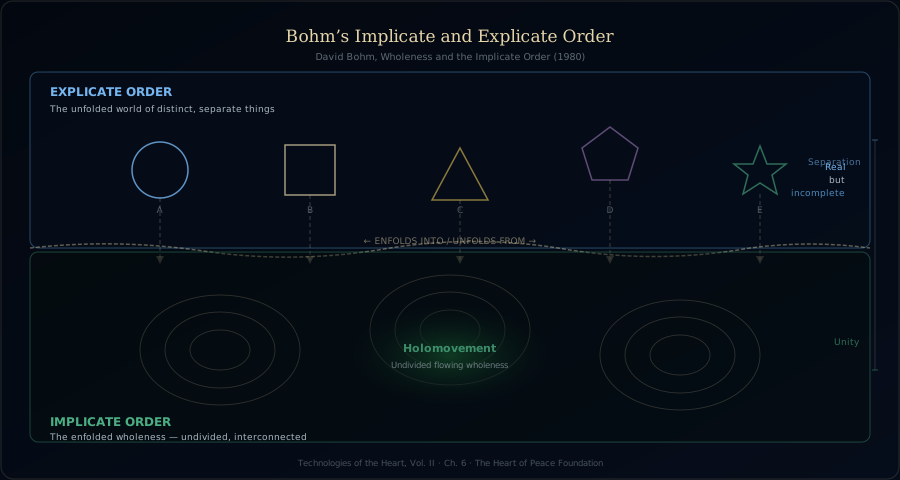
Bohm called this deeper level the implicate order — the "enfolded" order, in which everything is folded into everything else, and what appears as separation is always a local expression of a more fundamental unity. The level of ordinary experience — in which things appear as separate, locatable, distinct objects interacting across space and time — he called the explicate order: the "unfolded" order, real and important for practical purposes, but not the most fundamental description of what exists.
The key insight is this: Bohm was not saying that the apparent separateness of things is false or unreal. He was saying it is incomplete — that it is the real but secondary appearance of something deeper, in the way that a shadow is real but is not the object casting it. The chairs in the room are genuinely distinct from each other. You are genuinely distinct from me. But beneath that distinction is a deeper continuity — what Bohm called the holomovement — that neither of us can claim as "outside" ourselves.
Bohm spent the last decade of his life in dialogue with the Indian philosopher Jiddu Krishnamurti, exploring the implications of the implicate order for psychology, consciousness, and culture. Their conversations, collected in several volumes, repeatedly circled the same conclusion: the fragmentation of consciousness — the tendency to treat parts of the world, and parts of the self, as separate from each other — is not a natural feature of reality but a learned habit of perception. And habits of perception can be unlearned.
This is not mysticism. It is physics. But it arrives at the same place.
Ervin Laszlo and the Akashic Field
The Hungarian systems philosopher Ervin Laszlo, founder of the Budapest Club and author of more than seventy books, extended Bohm's framework in his 2004 work Science and the Akashic Field: An Integral Theory of Everything. Laszlo proposed that the quantum vacuum — the sea of zero-point energy that pervades all space — functions as the medium through which all systems in the universe remain connected and informed by each other.
Laszlo called this the Akashic field, borrowing the Sanskrit term Akasha (space, sky, ground) from Indian cosmology, in which the Akashic record was understood as the field in which all events leave permanent traces. Laszlo's scientific claim is more modest but structurally parallel: the quantum vacuum maintains what he calls "A-field coherence" — a non-local correlation of information across all systems that have ever interacted. Every particle, every organism, every ecosystem, every culture leaves traces in the vacuum field, and draws on those traces in processes we typically describe as coincidence, morphic resonance, intuition, or collective memory.
Whether or not Laszlo's specific hypothesis is confirmed by future physics, the framework it articulates is significant: it locates the scientific correlate of oneness not in a special mystical state but in the ordinary physics of the vacuum — the ground of being in which all things are permanently and unavoidably embedded.
Rupert Sheldrake and Morphic Resonance
Rupert Sheldrake (Cambridge, controversial but profoundly generative) proposed in his 1981 book A New Science of Life the hypothesis of morphic resonance: that all organized systems — molecules, organisms, societies, ecosystems — draw on and contribute to collective "morphic fields" that carry the accumulated patterns of their kind. A rat that learns a new maze in London makes it slightly easier for rats in Tokyo to learn the same maze, not through genetic transmission but through the morphic field of "rat-maze-learning" — a field that is updated by every instance of the behavior.
Sheldrake's hypothesis has not been definitively confirmed or refuted — it sits at the edge of testability in ways that make it difficult to evaluate through standard experimental methods. But it has driven important questions about the nature of biological memory, the mechanisms of collective learning, and the way in which organisms appear to draw on a history that is not stored in their individual nervous systems. It offers a biological language for what contemplative traditions call collective consciousness, ancestral wisdom, and the accumulated insight of lineages.
Whatever the ultimate fate of the hypothesis, the questions it raises are the right ones. How do organisms know things they haven't individually learned? How does a species carry adaptive information across generations faster than genetics can account for? How does a community of practice develop a collective intelligence that exceeds the sum of its members? The framework of morphic resonance is one attempt to answer these questions in scientific terms — and the answers it points toward are structurally consistent with what the recognition of oneness implies.
Neuroscience: The Brain's Oneness Mechanism
The most direct scientific evidence for the experiential reality of oneness comes from neurotheology — the study of the neural correlates of religious and spiritual experience. Andrew Newberg at Thomas Jefferson University has spent three decades imaging the brains of meditators, contemplatives in deep prayer, and individuals at peak moments of mystical experience. What he consistently finds illuminates both what oneness is and how it works.
The key region is the posterior parietal cortex — specifically the superior parietal lobule — which Newberg calls the "orientation association area" (OAA). This is the brain region responsible for constructing the spatial self-model: the sense of where the body ends and the world begins, the felt boundary between self and other, the orientation of the body in space. Under ordinary conditions, the OAA is continuously active, continuously refreshing the boundary between you and not-you.
During peak experiences of oneness — whether induced by deep meditation, intensive prayer, certain entheogenic substances, the overview effect, or spontaneous mystical experience — activity in the OAA decreases dramatically, sometimes nearly to zero. What the SPECT imaging shows, in other words, is that the felt dissolution of the boundary between self and world is not a hallucination or a malfunction of the brain. It is the quieting of a specific neural mechanism — one whose normal function is to construct a boundary that, at the phenomenological level, temporarily ceases to be constructed.
This finding is profoundly important. It means that the ordinary sense of being a bounded, separate self is not a direct perception of reality but a construction — a model, generated by a specific neural mechanism, that is useful for navigating the physical and social environment but that does not represent the final truth of what we are. And it means that the experience of oneness is not a departure from accurate perception but a temporary shift to a different mode of perception — one in which the constructing mechanism quiets and something else becomes available.
Francisco Varela, Evan Thompson, and Eleanor Rosch, in their landmark 1991 work The Embodied Mind, provided the cognitive science framework for understanding what that "something else" is. Their enactivist account of cognition proposed that the mind does not represent a pre-given world from inside the sealed container of a skull. It enacts a world through embodied action — through the ongoing, dynamic, mutually specifying relationship between organism and environment. The self and its world arise together, through each other, in a continuous process that has no fixed interior and exterior. The boundary between self and world is not a fact of nature; it is a practical stance, a useful simplification that collapses when examined closely enough.
Michael Persinger at Laurentian University demonstrated, controversially, that stimulating the temporal lobe with weak magnetic fields could induce experiences structurally similar to those reported in spontaneous mystical states — including the sense of a "sensed presence," the dissolution of boundaries, and feelings of cosmic unity. Reductionists cite this finding to suggest that oneness is "merely" brain activity. A more careful reading reaches the opposite conclusion: it reveals that the brain has dedicated neural machinery for accessing states of non-duality. Evolution does not maintain dedicated neural machinery for experiences that have no functional significance. The machinery for oneness exists because oneness is adaptive — perhaps the most adaptive recognition available to a species whose survival has always depended on cooperation, interdependence, and the recognition of shared fate.
Systems Theory: The Ecology of Oneness
Fritjof Capra, whose 1975 The Tao of Physics documented the structural parallels between quantum physics and Eastern mystical traditions, went on in The Web of Life (1996) to develop what he called a new scientific understanding of life — a systems theory in which the key insight is that life, at every scale, is characterized not by the properties of its components but by the relationships between them. A cell is not explained by listing its chemical constituents. It is explained by the dynamic network of relationships through which those constituents are continuously being organized, maintained, and renewed. The same is true of an organism, an ecosystem, a society, a civilization.
Capra's systems theory and Bohm's implicate order point in the same direction from different angles: the separateness of things, at every scale from the subatomic to the civilizational, is a secondary feature of an underlying relational wholeness. Understanding the parts without understanding the relationships that constitute them is not just incomplete — it is systematically misleading in ways that have produced the ecological, social, and psychological crises that define our historical moment.
IV. The Phenomenology — What Non-Dual Awareness Actually Feels Like
There is a long tradition of intellectual discussion of oneness that manages, somehow, to remain almost entirely abstract — as if oneness were a philosophical position to be argued for rather than an experience to be described. This section is an attempt to do the other thing: to describe, as precisely as language allows, what the recognition actually feels like from the inside.
The Structure of the Experience
The most consistent feature of reports from contemplatives, researchers, and ordinary people who have encountered peak experiences of oneness is that the experience is not felt as a loss of self but as an expansion of what self means. The ordinary sense of being a separate, bounded individual does not disappear; it becomes understood as a particular perspective within something larger — in the way that a wave does not disappear when it recognizes it is ocean, but becomes a wave that knows what it is.
William James, who collected and analyzed hundreds of mystical experience reports in his 1902 Varieties of Religious Experience, identified four structural features that appear consistently across traditions, cultures, and centuries: noetic quality (the experience has the felt character of insight — it delivers a recognition, not just a feeling), ineffability (it resists ordinary language, not because it is vague but because language is built for the world of separate things and strains at the edges of what oneness is), transiency (it does not last, though its effects do), and passivity (it arrives; it cannot be forced, though conditions can be cultivated that make it more available).
To these four, contemporary researchers add a fifth that is perhaps the most practically significant: noetic aftereffects. People who have had genuine experiences of oneness — whether through contemplative practice, near-death experience, the overview effect, or spontaneous mystical state — consistently report not just a temporary change in feeling but a sustained change in how they perceive and relate to the world. Values shift. Behavior changes. The motivation to compete and accumulate tends to decrease. The motivation to connect, contribute, and care tends to increase. The experience is not just pleasant. It is transformative in a direction that is measurably consistent across populations.
Three Descriptions From Inside
Thich Nhat Hanh (1987, Being Peace): "When I touch the interbeing nature of a flower, I touch the nature of reality itself. To be in touch with reality is to be in touch with what I am. The flower is not separate from the sun, the rain, the soil, and the gardener. I am not separate from my teacher, my students, the air I breathe, the food I eat. When I look at a flower, I am looking at reality. And when I look at reality, I am looking at myself."
This is not poetic license. It is a phenomenological description of what contemplative training — in Thich Nhat Hanh's case, decades of Zen practice in the Plum Village tradition — makes available as ordinary perception. The non-separation of things is not, for the trained contemplative, an occasional peak experience. It is the baseline quality of careful attention.
Hildegard of Bingen (12th century, Scivias): "I am the fiery life of divine substance — I blaze above the beauty of the fields, I shine in the waters, I burn in the sun, the moon, and the stars. And with the airy wind I quicken all things vitally by an unseen, all-sustaining life." What Hildegard is describing is not a vision of something outside herself. It is the direct phenomenological experience of recognizing that the "I" which speaks is not the small, bounded, skin-enclosed self but the larger life-force that moves through all things, of which the small self is a particular expression.
Albert Einstein (in a letter, 1950): "A human being is part of the whole called by us 'universe,' a part limited in time and space. He experiences himself, his thoughts and feelings as something separated from the rest — a kind of optical delusion of his consciousness. This delusion is a kind of prison for us, restricting us to our personal desires and to affection for a few persons nearest to us. Our task must be to free ourselves from this prison by widening our circle of compassion to embrace all living creatures and the whole of nature in its beauty."
Einstein, who by all accounts was not given to mystical extravagance, is here describing precisely the recognition that this chapter is about. Not as a feeling he occasionally had, but as his considered view of the human situation: separation is an optical delusion. Recognizing this is a liberation. The means of liberation is the widening of compassion until the distinction between self and other has become, not philosophically refuted, but practically irrelevant.
V. Cross-Cultural Lineages — Advaita, Buddhism, Sufism, Indigenous Cosmologies, Christian Mysticism
Advaita Vedanta: The Non-Dual Ground
Of all the world's philosophical and spiritual traditions, Advaita Vedanta — the school of Hindu philosophy most associated with the 8th-century philosopher Adi Shankaracharya and, in the modern era, with Ramana Maharshi and Nisargadatta Maharaj — has developed the most systematic and rigorous philosophical analysis of non-duality.
The central claim of Advaita is stated in the Sanskrit formula Tat tvam asi — "That thou art." That — Brahman, the ultimate ground of all being, the single reality that underlies all apparent multiplicity — is what you are. Not what you are connected to, not what you are part of, but what you are. The individual self (jiva) and the universal Self (Atman) are not two things in relationship; they are one reality seen from two perspectives. The recognition of this identity (moksha, liberation) is not an achievement that adds something new to what you are. It is the removal of the misunderstanding (avidya, ignorance) that made you think you were less than you are.
Shankaracharya's philosophical method, called viveka (discrimination), is essentially an analysis of what the self actually is, proceeding by the method of neti, neti ("not this, not this") — progressively identifying everything that changes, everything that comes and goes, everything that can be observed, as "not the self" — until what remains is the unchanging, unobservable, ever-present awareness in which all of that changing content appears. This is the sakshi, the witness — the pure awareness that is the self's deepest nature, identical to Brahman, already and always whole.
The philosophical argument is rigorous. But its destination is not a philosophical position. It is a recognition — one that Ramana Maharshi, teaching at Arunachala throughout the first half of the 20th century, transmitted not through elaborate doctrine but through the question Who am I? — a question designed to turn attention back toward the source of attention itself.
Buddhism: Interbeing and Dependent Origination
The Buddha's teaching of pratītyasamutpāda — dependent origination — is, in many respects, the most carefully argued formulation of interbeing in the philosophical record. The teaching is deceptively simple: nothing arises except in dependence on conditions. Everything that exists is what it is only because of everything else that exists. There are no independently existing things — only networks of mutually conditioning processes.
The implications are radical. If nothing exists independently, then the sense of a permanently existing, independently self-sufficient individual self is exactly what the Buddha called it: anattā — not-self. Not "there is no self" in the sense that you do not exist, but "what you have been taking to be a fixed, bounded, separate self is actually a dynamic, relational, process-like event that has no fixed boundaries."
Thich Nhat Hanh's contribution is to render this abstract philosophical teaching as a phenomenological practice. Interbeing — his translation of the Vietnamese tương tức — is not a doctrine to be believed but a quality of attention to be cultivated: the practice of looking at anything until you can see in it all the conditions that produced it. A sheet of paper contains the cloud that watered the forest. A loaf of bread contains the sun, the soil, the farmer, the miller. A person contains their parents, their culture, their language, the evolutionary history of their species, the biological history of life on Earth. The practice of interbeing is the practice of seeing this — not as an intellectual exercise but as a shift in perception that changes the felt quality of every encounter.
In the Mahayana tradition, this recognition gives rise to the figure of the Bodhisattva — the being who, having recognized the non-separation of self and other, vows to remain present in the world until all beings are free. The Bodhisattva's motivation is not self-sacrifice; it is the recognition that there is no "other" to sacrifice for. The suffering of any being is, in the most fundamental sense, one's own suffering — and its alleviation is simply what love does when it recognizes itself.
Sufism: The Wine of Unity
Ibn Arabi (1165–1240), the Andalusian mystic who is perhaps the greatest philosopher of oneness in the Islamic tradition, articulated the principle of Wahdat al-wujud — the oneness of being. There is only one being. All beings are expressions of the one being. The apparent multiplicity of individuals and objects is real — they genuinely differ — but that difference is the differentiation of a single reality that underlies and includes them all.
Ibn Arabi's cosmological vision is breathtaking in its scope: the universe is the self-disclosure of God — not God creating something separate from Himself, but the single reality differentiating itself into the infinite forms of experience in order to know itself through the mirror of its own reflections. Each created being is a mirror in which the one Being sees itself from a unique perspective. The mystic path is the progressive dissolution of the belief that the mirror is separate from what it reflects.
Rumi — Jalal al-Din Muhammad Rumi (1207–1273) — gave this recognition its most widely read expression in world literature. His Masnavi and Divan-e Shams are, among other things, phenomenological accounts of what the recognition of oneness feels like: the reed that cries for the reed bed it was cut from is the individual soul crying for the ground of being it has forgotten. When the recognition arrives — and in Rumi, it arrives in the form of mahabbat (divine love) — it is experienced not as loss but as homecoming. The separation was the exile. The recognition is the return.
Indigenous Cosmologies: The Web of Relations
Across Indigenous traditions on every inhabited continent, the recognition of oneness is not a philosophical position to be argued for but the baseline cosmological premise from which all reasoning proceeds. The Lakota concept of Mitákuye Oyásʼiŋ — "all my relations" — expresses, in a phrase used as both prayer and greeting, the recognition that the speaker is in relationship with all things: every creature, every element, every ancestor, every descendant, the land itself. This is not metaphor. It is the cosmological ground of ethics, medicine, governance, and daily practice.
Robin Wall Kimmerer, in her landmark 2013 work Braiding Sweetgrass: Indigenous Wisdom, Scientific Knowledge, and the Teachings of Plants, describes what happens when the Western scientific tradition — in which she is trained as a botanist — encounters the relational cosmology of her Potawatomi heritage. The encounter is not a collision but a recognition: the science keeps arriving, through its own methods, at conclusions that the Indigenous tradition encoded in its cosmology and its language. Potawatomi grammar, she observes, does not distinguish between animate and inanimate using the categories Western language assumes. A plant, a stone, a river — all are subjects, all are addressed as it only when the language of colonization replaces the language of relation. The recovery of relational grammar is, Kimmerer argues, a form of ecological healing: we cannot protect what we have made into an object.
The convergence between Indigenous ecological knowledge and contemporary systems science is not accidental. Both are the products of sustained, careful attention to the actual structure of living systems — attention that consistently reveals the same thing: the unit of life is not the organism but the relationship.
Christian Mysticism: The Eye Through Which God Sees
Meister Eckhart (1260–1328), the Dominican friar and mystic who produced some of the most philosophically audacious Christian theology in the medieval period, articulated the recognition of non-duality in terms that got him investigated for heresy:
"The eye through which I see God is the same eye through which God sees me: my eye and God's eye are one eye, one seeing, one knowing, one love."
This is the Christian formulation of Advaita's Tat tvam asi. Not "I am close to God," not "I am beloved by God," but "the seeing through which I see is the same seeing through which God sees — there is one seeing here, not two."
Eckhart's mystical theology is grounded in what he calls Gelassenheit — "letting go," "releasement" — the progressive dissolution of the will to maintain a separate self in the presence of God. This is not self-annihilation. It is the recognition that what one was trying to hold onto — the separate self — was never what one most deeply was. What remains after Gelassenheit is not nothing. It is the Seelenfünklein, the spark of the soul — the innermost ground of the self, which Eckhart identifies with the Gottheit, the Godhead: the ground of being that underlies even the personal God.
Thomas Merton (1915–1968), the American Trappist monk who spent the last decade of his life in dialogue with Buddhist and Hindu traditions, described an experience in 1968 at the Polonnaruwa rock sculptures in Sri Lanka that echoes John Glenn's overview effect: a sudden, overwhelming recognition of the oneness of all things — not as a theological proposition but as a direct perception — that he described as the ground of everything he had been seeking for twenty years. The recognition was not the product of a particular tradition. It was available to careful attention, regardless of the tradition that cultivated it.
VI. Philosophical and Spiritual Depth — The Metaphysics of Interbeing
The Problem of the Individual
Every philosophical tradition that has seriously engaged the question of oneness has had to address the same problem: if everything is one, what is the status of individuals? Do they exist? Do they matter? Is the recognition of oneness a reason to stop caring about individual persons, individual experiences, individual suffering?
The answer, across traditions, is uniformly: no. But the reason matters.
The individual does not disappear in the recognition of oneness. The wave does not disappear when it recognizes it is ocean. It becomes a wave that knows what it is — and its waveness is, if anything, more fully itself when it is no longer maintaining an anxious fiction of independence. Shankaracharya's teaching is not that the individual self does not exist but that it is not what it takes itself to be: not an isolated container of experience but a particular expression of the universal awareness that underlies all experience.
This distinction — between the self as isolated container and the self as particular expression of a larger whole — is not merely philosophical. It has direct practical consequences. The self as isolated container must compete for resources, must defend its boundaries, must accumulate enough to feel secure, must succeed in order to justify its existence. The self as expression of a larger whole can give from abundance rather than scarcity, can collaborate rather than compete, can receive without shame and offer without calculation, because its sense of being enough is not dependent on what it can hold.
This is not a fantasy. It is the lived experience of people in whom the recognition of oneness is stable and embodied — contemplatives, certain long-term meditators, people who have passed through profound grief or near-death experiences and emerged changed. Their behavior, systematically documented in hundreds of studies, shows precisely this shift: from self-protective accumulation toward open-handed contribution; from fear-based caution toward trust-based engagement; from competitive orientation toward collaborative one.
The Topology of Oneness
One of the most useful conceptual tools for understanding how oneness and individuality can coexist is the mathematical concept of the torus — a surface that folds back through itself, generating the appearance of an interior and an exterior while remaining topologically continuous. The torus is one surface; it has no separate inside and outside. Yet the curvature of that surface generates regions that function differently — what is on the "outside" of one part of the surface is connected to what is on the "inside" of another part through the continuous folding of the whole.
This is not a metaphor. Living systems — including the human electromagnetic field generated by the heart, first measured by James McCraty at the HeartMath Institute — have toroidal geometry. The heart's electromagnetic field extends in every direction from the body, folding back in a torus-like pattern that means the field is simultaneously inside the body and extending beyond it. There is no sharp boundary. There is a region of maximum intensity at the center and a gradually diminishing field that, technically, extends to the edge of the universe — which is to say, there is no edge at which the field definitively stops.
The individual and the universal are related as the center of the torus is related to its outer field: the same continuous surface, differentiated by curvature, without a definitive boundary between them.
Separation as a Skill, Not a Fact
One of the most practically important insights available from the recognition of oneness is the reframing it offers of the ordinary sense of separation. Separation — the felt experience of being a bounded, independent self — is not wrong. It is a skill — one that the human nervous system learned over millions of years of evolution because it was adaptive. The ability to distinguish self from other, to maintain the boundary of the individual organism, to act on behalf of oneself and one's immediate kin — these are real and necessary capacities.
But a skill, however useful, is not a fact. The ability to see objects as separate from each other does not mean that they are, at the deepest available level, separate. The ability to treat oneself as separate from one's environment does not mean that the self and the environment are, ultimately, different kinds of thing. The skill of separation is a way of interacting with the world that is appropriate in some contexts and dangerously misleading in others — specifically, in contexts where the health of the whole is being damaged by agents who are treating their separation as an ultimate fact rather than a useful approximation.
We are living in such a context. The ecological crisis is precisely the result of treating the separation of human civilization from the living systems on which it depends as if it were an ultimate fact rather than a pragmatic stance. The antidote is not the elimination of individual agency but its re-embedding in the relational whole that makes it possible — which is exactly what the recognition of oneness, made available through practice and cultivation, achieves.
VII. Practical Application — Living from Oneness
The Cultivation of Recognition
The recognition of oneness is not a belief that can be adopted through intellectual assent. It is an experience — one that has its own phenomenological texture, its own arising conditions, and its own methods of cultivation. The major contemplative traditions have spent millennia developing those methods, and while they differ in their cosmological frameworks and their social forms, they converge on a set of practices that are structurally similar:
Attention training (meditation, prayer, inquiry): The disciplined practice of turning attention back toward its own source — of noticing the awareness in which all experience arises — is the contemplative technology most consistently associated with the deepening of oneness. Whether it is called zazen in Zen, vipassana in Theravada Buddhism, lectio divina in Christian monastic tradition, muraqaba in Sufism, or contemplative prayer in any tradition, the structural move is the same: withdraw the outward-going attention from its objects and return it to the subject that is doing the attending. What is found, when this is done carefully and persistently, is not a small individual self attending to its own interior. It is an open, boundless awareness that was always already present but that was overlooked in the rush of ordinary attention.
Loving-kindness and compassion practices: The systematic extension of care — first to oneself, then to loved ones, then to neutral parties, then to difficult people, then to all beings — is a practice designed to dissolve the experiential boundary between the people to whom care comes naturally and the people to whom it does not. Over time, it dismantles the felt distinction between in-group and out-group that is one of the most powerful generators of the illusion of separation.
Nature immersion: Extended time in natural environments — particularly forests, oceans, and mountains, where the scale of the living system is large enough to make the individual feel small without feeling threatened — consistently induces shifts toward the phenomenology of oneness. The scientific literature on what researchers call "awe" — reviewed comprehensively by Dacher Keltner and Jonathan Haidt in their 2003 paper "Approaching Awe" — shows that awe reliably decreases self-referential thought, increases the felt sense of connection, and generates prosocial behavior. It is, neurologically and phenomenologically, a mild and accessible form of the overview effect.
Genuine service: The experience of whole-hearted service — acting for the benefit of another without any expectation of return, in a context where the service is genuinely needed — consistently generates a felt sense of connection and wholeness that practitioners of service-based traditions describe as one of the most reliable entry points into the recognition of oneness. The Bhagavad Gita calls this karma yoga — the yoga of action offered without attachment to fruits. The Christian tradition calls it agape — love that gives because it is love, not because it expects return. The recognition available in this experience is that the giver and the receiver are not, at the level of what is actually happening, as separate as the ego's accounting would suggest.
Try This Today
Find five minutes of uninterrupted quiet. Sit comfortably, close your eyes, and begin simply with this: breathe. Notice that the air you are breathing right now has been breathed by billions of other human beings. It has circulated through ancient forests and oceanic plankton and volcanic eruptions and the lungs of ancestors you will never know. It is not arriving from outside you into an enclosed self. It is the world moving through you, as you move through the world.
Stay with this for five minutes. Not as an idea to hold, but as an experience to inhabit.
Then notice what, if anything, is different about the quality of your presence when you return to your day. Notice whether the stranger you pass on the street, the colleague who annoys you, the news story that frightens you — whether any of them looks slightly different from the vantage point of something you cannot quite name but that feels, oddly, like recognition.
This is not a technique. It is an invitation. The recognition being invited is already present — it does not need to be created. It only needs the noise of ordinary self-preoccupation to quiet enough for it to be audible.
Oneness in the Ordinary
The recognition of oneness does not live primarily in meditation retreats or mystical experiences. Its natural habitat is the most ordinary moments of human life — when we notice it:
In listening: The moment when you genuinely set aside your own agenda and let another person's experience actually land — when their reality temporarily becomes more vivid to you than your own narrative about it — you have crossed, briefly, into the space the recognition describes. The Zulu word Sawubona — "I see you" — is not a greeting in the ordinary sense. It is a recognition of the other's full reality as a subject, not an object. Its use is the daily practice of oneness.
In forgiveness: The moment when you release another from the debt of having hurt you — not because what they did was acceptable but because holding the debt perpetuates a separation that costs you more than it costs them, and because, at some level you may not be able to articulate, you understand that they too were doing what they could from where they were — you have enacted the recognition of oneness in one of its most demanding forms.
In wonder: The moment when you encounter something — a landscape, a piece of music, a face, a mathematical truth, a child laughing — and your ordinary sense of being a separate, contained self temporarily dissolves into the encounter. What Wordsworth called "spots of time." What William James documented as "mystical experience." What the poet Mary Oliver practiced as a daily discipline, walking into nature with the intention of being undone. The reliable and repeatable dissolution of the boundary between subject and world — available, with practice, not just in extraordinary circumstances but in the attentive encounter with anything that is fully itself.
VIII. The Maslow Compass and Oneness
The Maslow Compass (available at /tools/maslow-compass) maps seven dimensions of human being across the full arc of the Hourglass described in Chapter 8. Among those seven dimensions, the one most directly illuminated by this chapter is the seventh: self-transcendence — the dimension that Maslow himself added to his hierarchy in 1969 but that the standard pyramid almost universally omits.
Self-transcendence, as Maslow described it, is not the height of personal development. It is the recognition that personal development was always already something more than personal. The person who has genuinely arrived at self-transcendence is not one who has conquered the self or dissolved it into some formless void. They are one who has recognized what the self actually is — not an isolated container of experience but a particular expression of a larger whole that is continuously sustaining, expressing, and recognizing itself through them.
The Maslow Compass is designed, in part, to help users distinguish between two very different experiences that can wear the same name. The first is genuine self-transcendence: an experience of oneness that arises from the ground of a well-developed, securely rooted individual self — an expansion, not an escape. The person in this state can function, decide, take responsibility, maintain relationships, and act in the world, while holding all of that activity within a larger context that makes the ego's usual anxieties feel proportionally smaller. The second is pseudo-transcendence: an experience of boundary dissolution that arises not from an expanded self but from a self that is avoiding its own development — using spiritual frameworks to bypass the work of becoming a whole, functional, caring person. The Compass's reflective questions are calibrated to reveal the difference: genuine self-transcendence strengthens a person's capacity to love, to work, to take responsibility, and to tolerate difficulty. Pseudo-transcendence consistently weakens these capacities, using the language of oneness to rationalize disengagement from the very relationships and commitments that oneness would otherwise deepen.
The third insight the Maslow Compass offers in this territory is perhaps the most practically significant. Self-transcendence is not a destination. It is a direction — a direction that can be moved in incrementally, in the middle of an ordinary day, through the quality of attention brought to any particular encounter. When a user engages the Compass's reflective questions about the seventh dimension — about how their sense of self relates to what is larger than the self, about what moves them beyond personal interest — they are not being evaluated on whether they have arrived at enlightenment. They are being invited to notice the direction their attention is currently moving: toward more expansive identification with the whole, or toward more defensive consolidation of the individual. And having noticed, to choose. Practiced daily, this noticing gradually shifts the user's operative sense of identity from the individual node to the relational field — not as a philosophical position, but as the baseline from which all other engagement proceeds.
IX. Integration with the Technologies of the Heart
This chapter is the culminating chapter of the Technologies of the Heart series for a reason: oneness is not just another technology alongside the others. It is the ground from which all the others flow, and the recognition toward which all of them, pursued deeply enough, point.
Chapter 1 — Generosity
Generosity — the first and foundational technology — becomes a different act when the recognition of oneness is present. Without that recognition, generosity is a moral achievement: a disciplining of the self-protective impulse in service of a value that reason endorses but emotion resists. With it, generosity is simply the natural movement of the hand caring for itself. If the self and the other are not ultimately separate — if the other's flourishing and my own flourishing are not independent variables — then giving is not sacrifice. It is investment in the only portfolio that actually exists: the health of the whole of which both giver and receiver are expressions. The neuroscience of generosity documents the felt experience of this recognition: the "warm glow" of giving is not a reward for virtue. It is the felt recognition of connection — the brief dissolution of the boundary between self and other that genuine giving makes available.
Chapter 2 — The Golden Rule
The Golden Rule — treat others as you would wish to be treated — is, in most ethical frameworks, a moral principle: an instruction to extend to others the consideration you naturally extend to yourself. But the recognition of oneness reveals what makes the Golden Rule not merely right but real. When the other is, in some fundamental sense, not ultimately separate from you — when their experience is, at the level of mirror neurons and interbeing and the implicate order, already partially your experience — then treating them well is not moral achievement. It is recognition. The Golden Rule becomes effortless not because it is easy but because the friction it was designed to overcome — the felt difference between self-interest and other-interest — has been dissolved by the recognition of what self actually includes.
Chapter 3 — Paying It Forward
Paying it forward — extending generosity to strangers who cannot repay you, in trust that the gift will move through the network of human connection — makes rational sense only if one feels some thread of connection to people one will never meet. That thread is precisely what the recognition of oneness provides: not an abstract moral commitment to a humanity one has never encountered, but a felt sense of belonging to something that includes those strangers. The person who has genuinely experienced the dissolution of self-other boundaries — even briefly, even incompletely — does not need an argument for why they should care about people they will never know. They have experienced, however fleetingly, that those people are not entirely other. Paying it forward is the practical expression of that experience.
Chapter 4 — Collaboration
Collaboration reaches its deepest possibility when the participants experience what Bohm called "dialogue" in his later work on collective intelligence: a quality of thinking together in which individual positions are held lightly enough for something genuinely new to emerge from the space between them. The "third thing" that genuine collaboration generates — the insight, the solution, the creative work that neither participant could have produced alone — is not a logical consequence of combining two sets of inputs. It is the local appearance of oneness: the moment participants experience themselves as part of something larger that generates through them. The geometry of collaboration, as described in Chapter 4, has its deepest roots in the recognition that the boundary between individual intelligences is, like all boundaries, provisional.
Chapter 5 — Compassion
Compassion — the grounded capacity to remain present to suffering without being consumed by it — is the experiential gateway to oneness that is most accessible to most people. The practice of sustained compassion — of remaining present to another person's pain long enough that the pain begins to feel less like "theirs" and more like a feature of the field you share — is, phenomenologically, an incremental dissolution of the self-other boundary. This is why genuine compassion, as distinct from pity, always has a quality of recognition: not "I feel sorry for you" but "I feel, with you, what you are carrying." The sustained practice of compassion, pursued to its depths, arrives at the recognition that the distinction between feeling and being felt is thinner than ordinary consciousness reports. This is the gateway to oneness that does not require special circumstances or extraordinary practices — it is available in every genuine human encounter.
Chapter 7 — The Toroidal Economy
The Toroidal Economy is, in a certain sense, oneness made economic. The torus is the geometric form that most accurately represents the topology of oneness: a single continuous surface that folds through itself, generating the appearance of interior and exterior, self and world, giving and receiving, without ever separating them. The toroidal economy works — to the extent that it does — because it is organized on the recognition that what is offered to the community eventually returns to the individual who offered it, not as a transaction but as a feature of the circulatory system of a living whole. This is not idealism. It is a structural description of how ecosystems work, how healthy communities function, and how the electromagnetic field of the heart operates. The Toroidal Economy is the application of this structural insight to the organization of material exchange.
Chapter 8 — The Hourglass of Being
The Hourglass of Being — the reimagining of Maslow's hierarchy as two pyramids joined at the heart — is the map of what it means to be a human being in full circulation: nourishing oneself from the ground up and offering oneself from the heart outward simultaneously. The apex of both pyramids — self-transcendence — is precisely the recognition described in this chapter: the point at which the upward developmental current (becoming more fully oneself) and the downward expressive current (offering that self to the world) reveal themselves as the same continuous movement. The Hourglass does not point toward oneness as a destination. It describes it as the living geometry of a fully functioning human being.
Chapter 9 — Intention, Motivation, and Purpose
Purpose — the third of the IMP triad described in Chapter 9 — is discovered, fully, only in the moment one recognizes that "for whom" one acts is not merely the individual self. Intention and motivation can be entirely self-referential — and often are. Purpose cannot. By definition, purpose orients toward something beyond the agent: a community, a generation, a species, a value. The recognition of oneness makes purpose not a moral obligation to adopt but a natural consequence of expanded self-perception. When the self I identify with includes not just this body and this biography but the relationships, communities, and living systems of which I am part, then acting for the benefit of those systems is not altruism. It is self-care, understood at the right scale.
Chapter 10 — The Generosity Standard
The Generosity Standard rests, in its deepest form, on the willingness to extend oneself — resources, attention, skill, time — for the benefit of another, without certainty of return. This willingness is, in most circumstances, the most practically demanding expression of the recognition of oneness that ordinary life requires. It asks the individual to act from the recognition of connection even when the connection is not currently felt — to practice oneness as a discipline when oneness is not yet stable as a perception. The Generosity Standard is the behavioral expression of the recognition this chapter describes: the practical test of whether the recognition of non-separation has been integrated into the ordinary choices of an ordinary day.
Why This Matters Now
We are living through a crisis that is, at its root, a crisis of separation. The ecological crisis is a crisis of separation: civilization organized on the premise that human beings can extract from living systems indefinitely without harming themselves, because the damage happens "over there." The political crisis is a crisis of separation: democracies organized around ever-more-rigid tribal identities treating fellow citizens as adversaries rather than collaborators. The psychological crisis is a crisis of separation: an epidemic of loneliness documented in study after study, persisting amid digital hyper-connection, because human beings have organized their lives around individual achievement and individual survival — and are discovering, over and over, that this diet does not nourish.
The antidote to all three is not a political program or a new technology. It is a different recognition — the oldest one available, the one every contemplative tradition and now several scientific disciplines have been arriving at independently: you are not as separate as you have been led to believe. From that recognition, everything else in this series becomes not just possible but natural.
X. Conclusion
In 1944, one of the greatest physicists of the twentieth century sat down to write a letter about death. Erwin Schrödinger — the Austrian Nobel laureate who gave quantum mechanics its most enduring image — was writing to the mother of a friend who had died in the war. He wrote:
"This life of yours which you are living is not merely a piece of the entire existence, but is in a certain sense the whole. Thus you can throw yourself flat on the ground, stretched out upon Mother Earth, with the certain conviction that you are one with her and she with you. You are as firmly established, as invulnerable, as she."
This was not mysticism from a confused mind. It was the considered conclusion of a physicist who had spent his career studying the mathematical structure of reality — and who had arrived, through that rigorous path, at the same recognition that Shankaracharya and Rumi and Meister Eckhart and Thich Nhat Hanh and Black Elk and Hildegard of Bingen had been articulating for centuries.
That recognition is available to you. Not as a conclusion to accept on the authority of physicists and mystics — though the convergence of their testimony is striking. But as an experience that can be cultivated, deepened, and made increasingly stable through the practices described in this chapter and throughout this series.
You have traveled through six chapters of this series. Each one has described a technology — a practice, an orientation, a capacity — that changes what is possible in human relationships and human communities. Generosity. The Golden Rule. Paying it forward. Collaboration. Compassion. Oneness.
These are not lessons you must learn. They are memories you must recover.
The generosity was already in you before you were taught to be cautious. The capacity for the Golden Rule was already in the mirror neurons firing before you had language to describe it. The impulse to pay it forward was already in the gratitude you felt when someone helped you in a way they didn't have to. The capacity for collaboration was already in the third thing that emerged the first time two people thought together and discovered something neither had known alone. The compassion was already in the flinch you felt watching another person's pain. And the oneness was already in every moment of wonder, every genuine encounter, every instant in which the boundary between self and world became transparent to something larger.
At the end of his life, the physicist David Bohm was asked what he most wanted people to understand about his work. He said: the essential thing is not any specific finding, but the general attitude — the willingness to see the whole before the parts, to hold the possibility that what appears to be separate may not be, fundamentally, separate at all.
This is also what The Heart of Peace Foundation is built to cultivate: not a specific belief, not a specific practice, not a specific community — but a quality of seeing and being that makes all the technologies in this series not obligations to fulfill, but expressions of what we already, at the deepest level, are.
Notice what you are experiencing right now, at the end of this chapter. The aliveness. The recognition. The sense that something you already knew has been named more clearly. That is not a response to an argument. That is the technology working.
Now: live it.
Next Steps
- Begin Chapter 7: The Toroidal Economy → — How the recognition of oneness transforms the structure of economic life
- Try the Maslow Compass → — Map your own movement across the seven dimensions, including self-transcendence
- Explore the full series: Technologies of the Heart →
- Get Involved with THOPF → — Add your presence to the whole
Related Articles
- Chapter 1: The Art & Science of Generosity — The first technology, from which the series begins
- Chapter 5: Compassion as Inner Clarity — The inner technology from which oneness becomes most accessible
- Chapter 7: The Toroidal Economy — Oneness made economic — the geometry of a generative circulation
- Chapter 8: The Hourglass of Being — The living geometry of a fully flourishing human being
- Technologies of the Heart — Series Overview — All chapters in context
- Our Mission — The Foundation of THOPF — How these recognitions shape everything we do
FAQ
What does oneness mean philosophically?
Philosophically, oneness refers to the recognition that the apparent multiplicity and separateness of distinct entities — including the apparent separation between self and world, self and other, individual and community — is a real but incomplete description of reality. The most rigorous philosophical traditions that have engaged this question — including Advaita Vedanta, Madhyamaka Buddhism, Neoplatonism, and certain currents in process philosophy — do not claim that individuals do not exist. They claim that the existence of individuals is not the kind of independent, self-sufficient existence that ordinary consciousness assumes. Everything that exists, exists in a web of relationships that are constitutive of its being, not merely additional features of it. Philosophically, oneness is the recognition that relationship goes all the way down.
Is there scientific evidence for oneness or interconnectedness?
Yes, from multiple independent disciplines. Quantum physics established through the work of John Bell and the experimental confirmation by Alain Aspect in 1982 that particles can remain correlated regardless of the distance between them — a phenomenon called quantum non-locality or entanglement that contradicts the classical assumption that separated things are causally independent. David Bohm interpreted this as evidence for an "implicate order" — a deeper level of reality in which everything is enfolded in everything else. In neuroscience, Andrew Newberg's imaging studies show that the brain region responsible for constructing the self-other boundary (the posterior parietal cortex) quiets during peak experiences of oneness, suggesting that the ordinary sense of separation is a constructed model rather than a direct perception. In ecology and systems theory, Fritjof Capra and others have documented that living systems are constituted by their relationships — their properties cannot be understood by analyzing components in isolation. The convergence of these independent disciplines on structurally similar conclusions is significant.
What is David Bohm's implicate order theory?
David Bohm's implicate order theory, developed in his 1980 book Wholeness and the Implicate Order, proposes that reality has two fundamental levels. The explicate order is the level of ordinary experience: the world of separate, locatable objects interacting across space and time. The implicate order is the deeper level, in which everything is "enfolded" in everything else — in which what appears as separation is actually a particular unfolding of an underlying wholeness that Bohm called the holomovement. Bohm grounded this proposal in the actual structure of quantum mechanics, particularly in the phenomenon of quantum entanglement, which he argued demonstrates that the separateness of particles is not a fundamental feature of reality but a feature of how we observe it. The implicate order is not a mystical concept; it is a rigorous scientific proposal about the structure of reality that has significant implications for how we understand consciousness, cognition, and the relationship between self and world.
What is "interbeing" according to Thich Nhat Hanh?
Interbeing (tương tức in Vietnamese) is Thich Nhat Hanh's term for the recognition, rooted in the Buddhist teaching of dependent origination (pratītyasamutpāda), that nothing exists independently of the conditions that produced it and continue to sustain it. A sheet of paper contains the cloud that watered the forest, the sun that powered the photosynthesis, the logger, the mill, the centuries of evolution that produced trees. A person contains their parents, their culture, their language, the food they have eaten, the people who loved them. Interbeing is not a metaphor; it is a description of causality taken seriously all the way down. Thich Nhat Hanh uses it as both a philosophical claim and a contemplative practice: looking at any thing until you can see, within it, the entire web of conditions from which it arose. The practice gradually dissolves the felt sense of isolation — the sense that the self is a separate container of experience — and replaces it with a felt sense of belonging to a living web of relations.
What is Advaita Vedanta and non-dual awareness?
Advaita Vedanta is a school of Hindu philosophy, most systematically articulated by the 8th-century philosopher Adi Shankaracharya, that holds that reality is ultimately non-dual — that Brahman (the absolute, the ground of all being) is the only ultimately real entity, and that the apparent multiplicity of individual selves and objects is maya — not illusion in the sense of "false," but in the sense of "not the whole story." The individual self (jiva) and the universal Self (Atman) are, in Advaita's formulation, ultimately identical — expressed in the Upanishadic formula Tat tvam asi ("That thou art"). Non-dual awareness is the direct experience of this identity — not as a philosophical conclusion but as a lived recognition in which the ordinary sense of being a bounded, separate individual is revealed as a learned construction, and something more fundamental — open, boundless, undivided awareness — is recognized as what one most deeply is.
How does quantum physics relate to mystical ideas about oneness?
The relationship is structural, not identical. Quantum physics does not "prove" mystical traditions correct, and mystical traditions are not making empirical claims that quantum experiments could confirm or refute. What they share is a structural convergence: both arrive, from completely different directions and through completely different methods, at the conclusion that the separateness of things is not a fundamental feature of reality. Quantum non-locality (the fact that entangled particles remain correlated regardless of distance) contradicts classical locality in a way that is structurally parallel to the contemplative claim that self and world are not ultimately separate. Bohm's implicate order, as a physical interpretation of quantum mechanics, uses different language but describes something structurally similar to what Advaita Vedanta calls Brahman and Buddhism calls shunyata (emptiness of independent existence). The convergence does not make physics and mysticism the same thing. It suggests they may be describing the same structural feature of reality from different observational positions — which is itself a significant fact.
How do you experience oneness in daily life?
Oneness in daily life arrives most reliably in moments of genuine attention — not special, manufactured attention, but the ordinary quality of care that is available in any encounter when it is met fully. In listening to another person with genuine presence — not waiting for your turn to speak but actually letting their reality land — the felt boundary between self and other becomes temporarily less rigid. In doing work that genuinely matters to you, where the distinction between "what I want to do" and "what needs to be done" collapses into the same movement. In forgiveness — the moment of release in which the grievance that has been maintaining a separation is set down. In nature — the felt sense of belonging to something larger that arrives reliably in forests, on coastlines, under open sky. In any moment of wonder, where the ordinary self-preoccupation pauses long enough for something other than oneself to become fully real. These are not exotic states. They are the texture of a life in which the recognition of oneness has been, however partially, integrated — a life in which the technologies described in this series are not obligations to fulfill but natural expressions of what turns out to have been true all along.
Further Reading
- David Bohm — Wholeness and the Implicate Order (1980, Routledge) — The physicist's rigorous formulation of oneness as the fundamental structure of reality; the most important scientific text for understanding the implicate order
- Thich Nhat Hanh — Interbeing: Fourteen Guidelines for Engaged Buddhism (1987, revised 2020, Parallax Press) — The contemplative formulation of interconnection as daily practice; accessible and precise
- Fritjof Capra — The Tao of Physics (1975, Shambhala) and The Web of Life (1996, Anchor Books) — Documenting the structural convergence between quantum physics, systems theory, and Eastern cosmologies
- Ervin Laszlo — Science and the Akashic Field: An Integral Theory of Everything (2004, Inner Traditions) — The systems philosopher's proposal for a scientific correlate of the oneness traditions' concept of a ground of being
- Francisco Varela, Evan Thompson & Eleanor Rosch — The Embodied Mind: Cognitive Science and Human Experience (1991, MIT Press) — The enactivist account of mind as arising through the mutually constitutive relationship of organism and environment; philosophically dense but essential
- Robin Wall Kimmerer — Braiding Sweetgrass: Indigenous Wisdom, Scientific Knowledge, and the Teachings of Plants (2013, Milkweed Editions) — A botanist's account of what it means to be part of a living world rather than separate from it
- Martin Buber — I and Thou (1923, Walter Kaufmann translation recommended, Scribner) — The philosophical phenomenology of genuine encounter; perhaps the most accessible entry point into the experiential dimension of oneness
- William James — The Varieties of Religious Experience (1902, Harvard University Press) — The foundational empirical study of mystical experience, including peak experiences of oneness, across traditions
- Andrew Newberg & Mark Waldman — How God Changes Your Brain (2009, Ballantine Books) — The neurotheological research on the neural correlates of spiritual experience, including the quieting of the self-other boundary
- Frank White — The Overview Effect: Space Exploration and Human Evolution (1987, Houghton Mifflin) — The foundational study of the overview effect, documenting the consistent shift in self-perception reported by astronauts who have seen the Earth from orbit
Glossary
Interbeing: A term coined by Thich Nhat Hanh to describe the condition of mutual arising — the recognition that nothing exists independently of its relationships. All things, persons, and events arise in dependence on the conditions that produced them and continue to sustain them. Not a mystical claim but a precise description of causality, extended to include its relational implications. The contemplative practice of interbeing involves looking at any phenomenon until the web of conditions that produced it becomes visible within it.
Implicate Order: David Bohm's term for the deeper level of reality, beneath the level of ordinary experience (the "explicate order"), in which everything is "enfolded" in everything else. The apparent separateness of things is a real but secondary feature of the underlying wholeness — what Bohm called the holomovement. The implicate order is grounded in quantum entanglement: the fact that once-entangled particles remain correlated regardless of distance is Bohm's evidence that separation, at the deepest available level of physical description, is not a fundamental feature of reality.
Non-dual Awareness: The mode of consciousness in which the ordinary sense of being a bounded, separate self — constructed by the posterior parietal cortex and continuously refreshed under ordinary conditions — temporarily or permanently quiets, and what remains is recognized as open, boundless awareness that is not confined to the individual. Non-dual awareness does not eliminate the individual; it reveals the individual as a particular expression of a larger continuity. It is the experiential correlate of what Advaita Vedanta calls moksha, Buddhism calls satori or nirvana, Sufism calls fana, and Christian mysticism calls unio mystica.
Quantum Non-Locality: The experimentally confirmed feature of quantum mechanics — demonstrated decisively by Alain Aspect's 1982 Bell test experiments — in which entangled particles remain correlated regardless of the distance between them. This contradicts classical locality (the assumption that separated things cannot influence each other instantaneously) and has been interpreted by David Bohm and others as evidence for an underlying wholeness in which apparent separation is a secondary, emergent feature rather than a fundamental fact.
Ubuntu: A southern African philosophical principle, most fully expressed in Zulu as umuntu ngumuntu ngabantu ("a person is a person through other persons"). Ubuntu holds that personhood is not a property of isolated individuals but an achievement of relationship and community — that the self is constituted, rather than merely informed, by its connections. Ubuntu has been extensively studied as a framework for ethics, governance, and organizational life by scholars including Mogobe Ramose and Drucilla Cornell, who have argued that it offers resources for addressing the ethical deficits of purely individualist models of personhood.
Wahdat al-wujud: The Sufi principle articulated most fully by Ibn Arabi (1165–1240), meaning "oneness of being." The claim that there is only one being — that all apparently distinct beings are expressions or self-disclosures of the single reality — and that the mystic path is the progressive dissolution of the mistaken belief in the ultimate separateness of the individual self from this single ground. The most widely read literary expression of this principle is the poetry of Rumi.
Morphic Resonance: Rupert Sheldrake's hypothesis that all organized systems draw on and contribute to collective "morphic fields" that carry the accumulated patterns of their kind — a non-genetic mechanism of collective memory and collective learning. While not definitively confirmed, the hypothesis has driven important questions about how organisms access information that is not stored in their individual nervous systems and how communities of practice develop collective intelligence that exceeds the sum of their members.
The Heart of Peace Foundation cultivates compassion, generosity, and human flourishing through mindfulness, community nourishment, and spiritual growth in Charlotte, NC and beyond. Explore our programs or get involved to bring these technologies into your community.